
Last Updated: June 2026 | Reading Time: 10 min | Category: Real Estate & Property Law
A lock-in period in a lease agreement is one of those clauses most people skim past at signing – until the day they need to move out early and discover it could cost them several months of rent. Whether you are a tenant renting a flat in Bengaluru, a business leasing office space in Mysuru, or a landlord protecting your rental income, understanding the lock-in period in a lease agreement can save you money, disputes, and a great deal of stress.
This guide explains, in plain language, what a lock-in period means, how it differs from the notice period and the lease term, how long it typically runs in India, what happens if you break it, and whether it is legally enforceable.
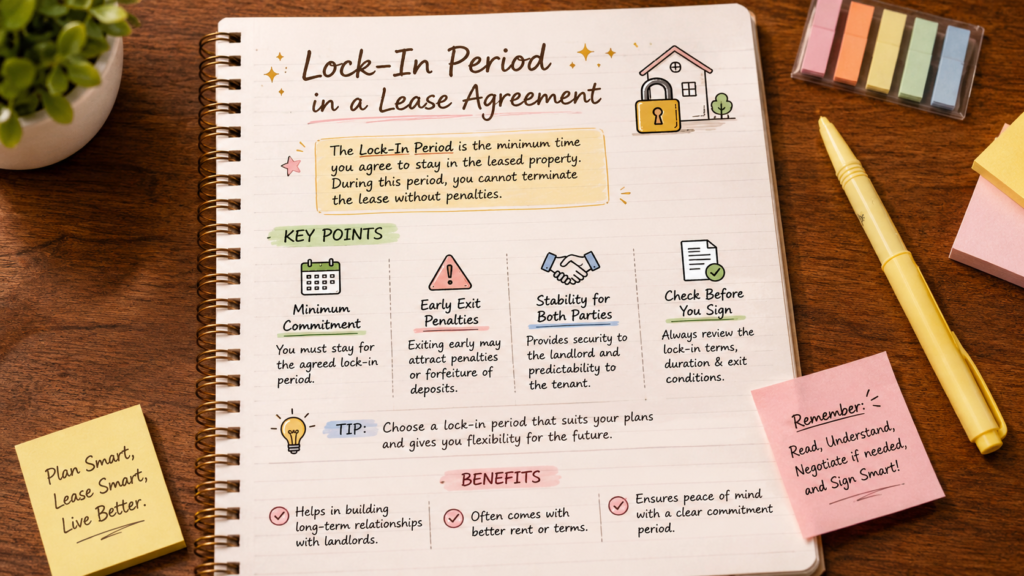
Quick answer: A lock-in period in a lease agreement is a fixed minimum duration during which neither the tenant nor the landlord can terminate the lease. If either party exits early, they usually pay a penalty – commonly the rent for the remaining lock-in months, or forfeiture of the security deposit. In India there is no statutory minimum; the period is negotiated, and typically runs 6-12 months for residential leases and 1-5 years for commercial ones.
What Is a Lock-In Period in a Lease Agreement?
A lock-in period is the agreed window of time during which both the tenant and the landlord are committed to the lease and cannot walk away without consequences. In simple terms, both parties are locked in to the same deal for that duration. Neither side can serve a valid notice to vacate during this window without triggering a penalty defined in the agreement.
The clause exists to create certainty. The tenant is assured they will not be asked to leave on short notice – even if the owner gets a higher offer from someone else – and the landlord is assured of steady rental income for at least the locked-in months. It is a mutual commitment, not a one-sided restriction.
Lock-in clauses appear in both residential and commercial leases, but they matter most in commercial agreements, where landlords often spend heavily on fit-outs and tenants invest in interiors, signage, and operations. For both, the lock-in period turns a loose arrangement into a dependable commitment.
Lock-In Period vs Notice Period vs Lease Term
This is where most confusion happens. These three terms sound similar but mean very different things, and mixing them up can be expensive.
| Term | What it means | Example |
|---|---|---|
| Lease term | The total duration of the agreement | A 2-year (or 11-month) lease |
| Lock-in period | The minimum non-cancellable window inside the lease term | First 6 months cannot be terminated |
| Notice period | How much advance warning is needed to exit after the lock-in ends | 1-2 months written notice |
Here is how they work together. Suppose you sign an 11-month lease with a 6-month lock-in and a 1-month notice period. For the first six months, you cannot leave without penalty. After that, you can leave any time, provided you give one month’s written notice. The lease term is the outer boundary; the lock-in is the locked window at the start; the notice period governs how you exit once the lock is over.
Why Do Lock-In Periods Exist?
The clause protects both sides from sudden, costly termination – but each party values it for different reasons.
For landlords, a lock-in period guarantees uninterrupted rental income and reduces the risk of the property sitting vacant. Finding a new tenant takes time and money, and in commercial leases the landlord may have customised the premises for that specific tenant. The lock-in compensates for that effort and risk.
For tenants, the lock-in offers stability. A residential tenant gains protection from being evicted because a higher bidder appeared. A business tenant gains certainty over a location they have invested in – crucial when you have set up an office, a showroom, or a clinic and cannot afford to relocate on short notice.
How Long Is a Typical Lock-In Period in India?
There is no law in India that fixes a minimum or maximum lock-in period. It is purely a matter of negotiation between the parties. That said, clear norms have emerged in practice: residential leases usually carry 6 months to 1 year, while commercial leases typically run 1 to 5 years.
One India-specific point worth knowing: most residential rent agreements are written for 11 months rather than a full year. Under Section 17 of the Registration Act, 1908, any lease of 12 months or more must be compulsorily registered, which adds stamp duty, registration fees, and paperwork. Keeping the agreement to 11 months sidesteps mandatory registration.
What Happens If You Break the Lock-In Period?
Breaking a lock-in clause is not free. The exact consequence depends on what your agreement says, but the common outcomes are: if the tenant leaves early, they typically have to pay rent for the remaining months of the lock-in period, or forfeit all or part of the security deposit. If the landlord forces the tenant out early, they usually must compensate the tenant by refunding the deposit in full plus paying an equivalent penalty amount.
This is why you should never sign a lease without reading the lock-in and exit terms carefully. If you are still learning how property paperwork fits together, our guide to the main types of property deeds in India – which includes the lease deed – is a useful starting point.
Is a Lock-In Period Legally Enforceable in India?
Yes – lock-in clauses are generally enforceable under Indian contract law, provided both parties agreed to them and the terms are reasonable. The penalty for breaking a lock-in is treated as liquidated damages, which is governed by Section 74 of the Indian Contract Act, 1872.
Indian courts draw a sharp line between liquidated damages (a genuine pre-estimate of likely loss, which is enforceable) and a penalty (a punitive, excessive amount designed to punish, which is not fully enforceable). In the landmark cases of Fateh Chand v. Balkishan Das and later Kailash Nath Associates v. Delhi Development Authority, the Supreme Court held that the complaining party is entitled only to reasonable compensation, not to an unconscionable windfall.
How to Negotiate a Fair Lock-In Clause
A lock-in period is negotiable before you sign – almost never after. Doing your homework on documents and approvals upfront – the same diligence you would apply when checking whether a property is A Khata or B Khata – prevents the most common rental disputes.
What to Check in the Lock-In Clause Before You Sign
The lease deed is just one of several documents that define your rights in a property transaction. Understanding how it sits alongside others – for instance, the difference between a conveyance deed and a sale deed, or the role of property mutation after a purchase – gives you a far stronger position whether you are renting or buying.
Frequently Asked Questions
What is a lock-in period in a lease agreement?
A lock-in period is a fixed minimum duration in a lease during which neither the tenant nor the landlord can terminate the agreement without penalty. It locks both parties into the deal for that window, giving the landlord income security and the tenant occupancy stability.
Is there a minimum lock-in period under Indian law?
No. Indian law does not fix a minimum or maximum lock-in period. It is decided entirely by negotiation between the landlord and tenant. In practice, residential leases commonly use 6 to 12 months, while commercial leases often run 1 to 5 years depending on the investment involved.
Is a lock-in clause legally enforceable in India?
Yes, generally. Lock-in clauses are enforceable as liquidated damages under Section 74 of the Indian Contract Act, 1872, if both parties agreed and the terms are reasonable. Courts will reduce amounts that look like an excessive penalty rather than a genuine estimate of loss.
The Bottom Line
The lock-in period in a lease agreement is a small clause with large financial consequences. It protects both landlord and tenant from abrupt, costly termination – but only if it is fair, mutual, and clearly written. Before you sign, read it carefully, understand how it differs from the notice period and the lease term, and negotiate the duration and penalties to match your real situation.
At Elite Build, we believe informed buyers and tenants make better decisions. Whether you are renting, buying, or investing in property across Mysuru and Karnataka, understanding the paperwork is the first step to protecting your money. If you are ready to own rather than rent, explore our luxury villas in Mysore, apartments in Mysore, and individual houses in Mysore where ownership is clean and documentation is complete from day one.
Disclaimer: This article is for general informational purposes only and does not constitute legal advice. Lease laws and their interpretation vary by state and by individual circumstance. Please consult a qualified property lawyer before drafting, signing, or terminating any lease agreement.