
Stilt Parking: Meaning, Rules, and Advantages for Apartment Buyers in India (2025)

Stilt Parking

When you visit a residential apartment project in Bangalore or any Indian city today, you will almost always notice the ground floor designed not as a living space but as a covered, column-supported area for vehicles. That is stilt parking — and if you are an apartment buyer, a homeowner, or a real estate investor, understanding it fully can protect you from legal surprises and help you make a smarter purchase decision.

This guide covers everything you need to know: what stilt parking is, how it works, the legal framework under RERA and the Supreme Court, how it compares to other parking types, and what buyers in Bangalore and Karnataka must specifically watch out for in 2025 and 2026.

What is Stilt Parking? (Clear Definition)

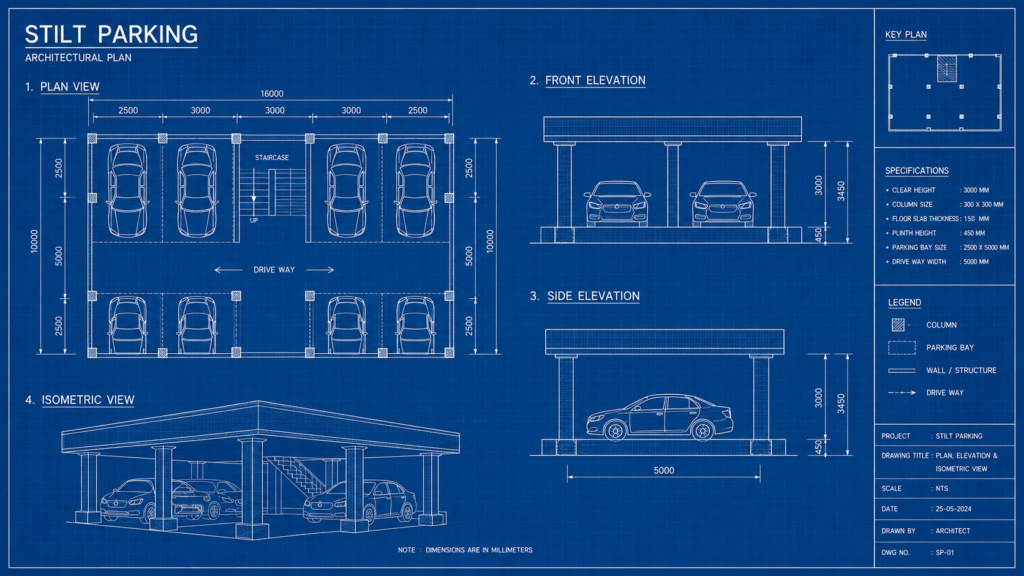
Stilt parking is a parking arrangement built at the ground floor of a residential or commercial building, where the structure above is supported by vertical columns or pillars (called stilts). The space between these columns remains open on the sides and is used exclusively for parking vehicles.

The term “stilt” refers to the raised platform technique — the building is essentially lifted above the ground level on structural columns, creating a sheltered but partially open space beneath for vehicles.

Key characteristics of stilt parking:

  • Located at ground level or slightly elevated
  • Supported by reinforced concrete or steel columns
  • Partially open on sides (not fully enclosed like a basement)
  • Minimum height of 8 feet as per Indian building norms
  • Common in mid-segment to premium residential apartments

Stilt parking is distinct from basement parking (fully underground) and open surface parking (no shelter at all). It occupies the middle ground — protected from rain and sun, yet naturally ventilated.

How Does Stilt Parking Work Structurally?

The engineering logic of stilt parking is straightforward. The entire weight of the upper floors rests on load-bearing columns that are embedded into the foundation. These columns are designed to handle the full structural load, leaving the ground-level floor slab free of walls or enclosures on most sides.

Because the ground level is mostly open, stilt parking also benefits from natural ventilation and light at street level. Residents can drive directly into allocated slots from the main gate — making entry and exit fast without ramps or excavation costs associated with basement parking.

The stilts themselves are typically made of reinforced concrete (RCC) and designed by structural engineers to meet the safety requirements of the National Building Code of India.

Stilt Parking Rules and Legal Framework in India

This is where most apartment buyers face confusion. Stilt parking in India is governed by three key legal pillars: the Supreme Court, RERA, and state-specific building bylaws.

1. Supreme Court Ruling (2010) — The Landmark Judgment

The most important legal precedent on stilt parking was set in the Nahalchand Laloochand Pvt. Ltd. vs Panchali Co-operative Housing Society Ltd. [AIR 2010 SC 3607] case.

A bench of Justices A.K. Patnaik and R.M. Lodha ruled clearly that stilt parking spaces cannot be sold as independent units by developers. The court classified stilt and open parking spaces as common areas of a housing complex, meant for the shared use and convenience of all residents.

What this means for buyers:

  • Builders cannot charge you separately for stilt parking as a standalone unit
  • Stilt parking space belongs to the housing society, not to any individual flat owner
  • The right to use a specific slot is allocated by the society — it is not owned

2. RERA Guidelines on Stilt Parking

Under the Real Estate (Regulation and Development) Act, 2016, stilt parking is classified as part of the common areas of a project. RERA mandates:

  • Developers must clearly specify the number of stilt parking slots in the project’s approved layout and sale agreement
  • Stilt parking dimensions, locations, and ramp slope details must be disclosed
  • These spaces cannot be sold separately to individual flat owners
  • Once the project is handed over, stilt parking management passes to the Resident Welfare Association (RWA) or Apartment Owners Association (AOA)

Builders can only recover the cost of construction of the parking area — they cannot price stilt slots as independent property units.

3. Karnataka and Bangalore Specific Rules (2025–2026)

For homebuyers in Bangalore and Karnataka, there are additional compliance layers:

  • Karnataka Apartment Ownership Act: Recognises stilt parking as common area; residents get right of use, not ownership
  • K-RERA 2026 Updates: Builders must specify exact parking slot numbers, sizes, and locations in sale agreements — vague promises about parking are no longer legally valid
  • BBMP Parking Bylaws (Section 16): Each off-street parking space must be a minimum of 18 sq. meters (3m x 6m) for cars
  • Parking Policy 2.0 (DULT, Karnataka): Introduces a permit-based system for residential parking in urban areas
  • Penalty: RWAs are empowered to fine residents ₹1,000 for unauthorised parking and initiate towing

Key buyer tip for Bangalore: If a builder is offering to “sell” you a stilt parking slot at a premium as a separate unit, that is legally not permissible. Ask for the sanctioned building plan and verify that the stilt area is shown as a common area.

Types of Parking in Apartments: Stilt vs Basement vs Open

Understanding how stilt parking compares to other options helps you evaluate any project more accurately.

Feature Stilt Parking Basement Parking Open Parking
Location Ground floor, under building Underground Surface level
Weather Protection Partial (open sides) Full None
Construction Cost Low to medium High Low
Legal Status (India) Common area Common area Common area
Ventilation Natural Mechanical needed Full natural
Flood Risk Low (elevated) Higher Medium
Security Good (within premises) Good Lower
Common in Mid-segment projects Premium projects All segments

Basement parking, while offering better weather protection, involves significantly higher construction costs due to excavation and waterproofing. Stilt parking is the more cost-efficient and practical solution for most urban residential projects in India — which explains its near-universal adoption in cities like Bangalore, Pune, Hyderabad, and Chennai.

Advantages of Stilt Parking for Homebuyers

If a project offers well-designed stilt parking, here is what you stand to gain:

1. Vehicle Protection from Weather

Stilt parking provides shade from direct sun and shelter from rain, protecting your vehicle’s paint, interiors, and mechanical parts from weather-related wear over time.

2. Better Security than Street Parking

Since the stilt area sits within the gated premises of the apartment complex, vehicles are far less exposed to theft, vandalism, or accidental damage from outside traffic.

3. Convenience of Direct Access

Unlike multi-level car parking or tight basement ramps, stilt parking allows residents to drive in and out directly at ground level — faster and easier, especially for elderly residents or those with larger vehicles.

4. No Ramp-Related Damage

Deep basement parking often involves steep ramps that can scrape low-clearance vehicles. Stilt parking at ground level eliminates this problem entirely.

5. Natural Ventilation Reduces Fire Risk

Because stilt floors are open on multiple sides, there is constant natural airflow. This reduces the accumulation of vehicular exhaust fumes and, importantly, reduces fire risk compared to enclosed basement parking.

6. Lower Maintenance Costs

Without waterproofing demands, drainage pumps, or mechanical ventilation systems required in basements, stilt parking areas have significantly lower upkeep costs — which means lower maintenance charges for residents.

7. Supports Higher FAR Utilisation

From a builder’s perspective, building on stilts means the ground floor is excluded from the Floor Area Ratio (FAR) calculation in many municipal frameworks. This allows developers to utilise the remaining floors more efficiently, which can translate into better amenities for buyers.

What to Check Before Buying an Apartment with Stilt Parking

If you are in the process of evaluating a residential project in Bangalore or elsewhere in Karnataka, here is a practical checklist:

Legal verification:

  • ✅ Is stilt parking shown as a common area in the approved building plan?
  • ✅ Is the number of parking slots mentioned in the property documents and sale deed?
  • ✅ Is the builder registered under K-RERA?
  • ✅ Does the agreement specify the slot allocation method (lottery, rotation, first-come)?

Physical inspection:

  • ✅ Is the stilt height at least 8 feet?
  • ✅ Is there adequate lighting and CCTV coverage in the stilt area?
  • ✅ Are fire safety norms met — including access to fire escape routes?
  • ✅ Is the ramp slope less than 1:10 (safe standard for vehicle access)?
  • ✅ Is there drainage to handle rainwater run-off?

Management clarity:

  • ✅ Who manages parking allocation post-handover — builder or RWA?
  • ✅ Are visitor parking bays clearly demarcated?
  • ✅ What are the monthly parking-related maintenance charges?

Common Misconceptions About Stilt Parking

Myth 1: “I own my stilt parking slot since I paid for it.”
Fact: You have the right to use a slot, not to own it. The slot belongs to the housing society. If the builder charged you a separate amount for the stilt slot as an independent unit, that is not legally valid.

Myth 2: “I can convert my stilt parking bay into a storage area.”
Fact: Stilt parking can only be used for vehicle parking. Conversion for any other use requires specific permissions and is typically prohibited.

Myth 3: “Stilt parking is unsafe during floods.”
Fact: Stilt parking is actually safer than basement parking during flooding events, as it is at ground level or slightly elevated, while basement parking is far more vulnerable to water ingress.

Myth 4: “All builders follow stilt parking rules.”
Fact: Despite Supreme Court and RERA guidelines, violations still occur. Buyers must verify documents and not rely solely on verbal commitments from sales teams.

Stilt Parking and the Future of Urban Housing in Bangalore

As Bangalore continues to grow — especially in the Outer Ring Road corridors, North Bangalore, and Mysuru Road belt — the demand for residential parking continues to outpace supply. Stilt parking remains a practical, cost-efficient solution for developers and residents alike.

Emerging trends in the segment include:

  • EV charging points in stilt areas: Several new projects are pre-wiring stilt bays for electric vehicle charging as part of green building certifications
  • Smart parking management: Digital slot allocation systems and QR-code-based visitor passes are becoming more common in premium projects
  • Tandem parking design: Two-car tandem bays in stilt areas are appearing in projects where space is at a premium
  • Integration with MLCP: In large township projects, stilt parking at lower floors is being combined with Multi-Level Car Parking towers to handle higher vehicle density

Frequently Asked Questions About Stilt Parking

Q1. What is stilt parking meaning in simple terms?
Stilt parking refers to a vehicle parking area built at the ground floor of a building, supported by vertical columns or stilts. It is partially open on the sides and provides shelter to parked vehicles from rain and direct sunlight.

Q2. Can a builder sell stilt parking separately in India?
No. The Supreme Court of India, in its 2010 judgment (Nahalchand Laloochand vs Panchali Co-op Housing Society), ruled that stilt parking spaces are common areas and cannot be sold as independent units. RERA also prohibits this practice.

Q3. Is stilt parking included in the flat price?
Yes, the cost of constructing the stilt parking area is typically included in the overall project cost. Builders cannot charge additionally for stilt parking as a separate property. However, allocation of a specific slot may involve a nominal administrative fee set by the housing society.

Q4. What are the height requirements for stilt parking in India?
The minimum height for stilt parking in India is 8 feet, as required by the National Building Code and local municipal building bylaws, to ensure all standard vehicle types can be accommodated.

Q5. Who allocates stilt parking slots to residents?
Before possession, the builder may provisionally allocate slots as per the approved layout. After handover, the Resident Welfare Association (RWA) or Apartment Owners Association takes over allocation — usually through lottery, rotation, or flat size-based assignment.

Q6. Is stilt parking safe for vehicles?
Yes, when properly constructed and maintained, stilt parking is safe. Vehicles are within the secured premises, protected from weather, and away from street-level traffic. Adequate lighting, CCTV, and regular maintenance by the housing society ensure ongoing safety.

Q7. What is the difference between stilt parking and basement parking?
Stilt parking is at ground level, open on the sides, naturally ventilated, and lower in construction cost. Basement parking is underground, fully enclosed, requires mechanical ventilation, and involves higher construction and waterproofing costs. Both are legally classified as common areas under Indian law.

Q8. What happens if a builder illegally sells stilt parking?
Buyers can file a complaint with their state RERA authority. In Karnataka, complaints can be filed on the K-RERA portal (rera.karnataka.gov.in). The builder can face penalties, and the transaction may be declared void.

Conclusion

Stilt parking is one of the most practical, widely-adopted parking solutions in Indian residential real estate. For apartment buyers — particularly in urban markets like Bangalore, Mysuru, and other Tier 1 and Tier 2 Karnataka cities — understanding the legal framework around stilt parking is not optional. It is essential.

The bottom line: stilt parking is a common area, not private property. You have the right to use an allocated slot, but the space legally belongs to your housing society. Before signing any agreement, verify that parking details are clearly mentioned, that the builder is RERA-registered, and that no one is charging you for stilt parking as a standalone unit. Once possession is completed, ensure you complete property mutation so administrative records accurately reflect the new ownership.

A well-designed stilt floor with adequate lighting, security, and vehicle charging infrastructure adds genuine value to a residential project. When evaluating your next apartment purchase, ask the right questions about parking — it is a detail that affects your daily life for years to come.

Scroll to Top