
You signed the sale deed. You paid stamp duty. You collected the keys. You think the property is yours.
Legally, yes. Administratively, not yet.
Until you complete property mutation, the government still treats the previous owner as the rightful holder for tax, utility, and record-keeping purposes. This single gap is the reason thousands of Karnataka property owners face loan rejections, resale delays, and tax notices going to the wrong person years after purchase.
This guide explains exactly what mutation in property means in Karnataka, how the process works in Mysuru and Bengaluru after the 2024 e-Khata digitisation and February 2026 guidance value revision, and the practical traps that delay 70% of applications.
What Is Mutation in Property?
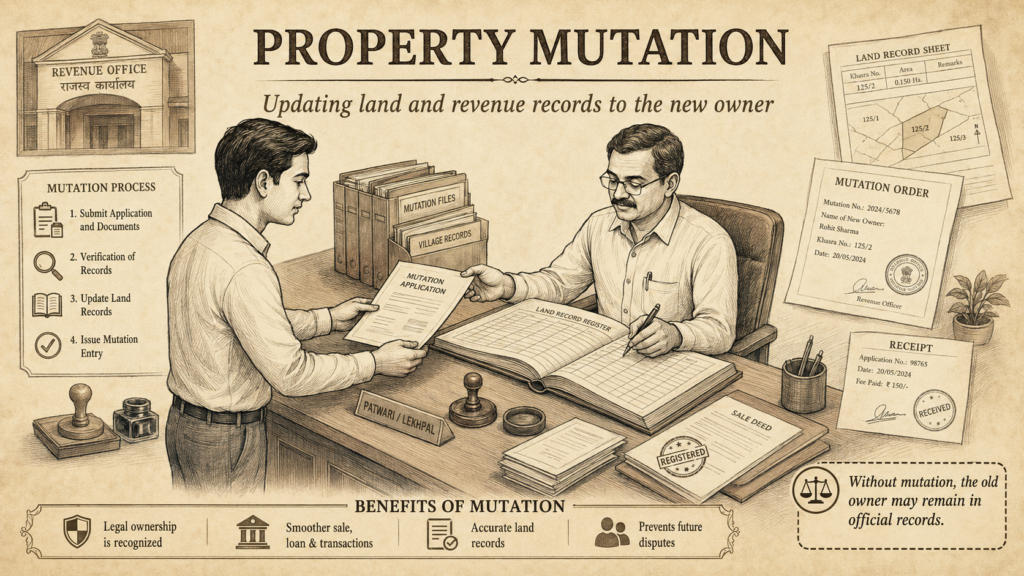
Property mutation is the process of updating government records to reflect a change in ownership after registration. It is the administrative follow-through that completes what your sale deed legally accomplished.
In Karnataka, this update lives in two parallel systems: Urban property (Mysuru, Bengaluru, Mangaluru, Hubballi) through the e-Khata portal maintained by the city municipal body. Rural and agricultural land mutation means updating the RTC (Record of Rights, Tenancy and Crops) through the Bhoomi Karnataka portal or the Village Accountant at the Taluk office.
The Single Most Important Distinction: Mutation Is Not Registration
| Aspect | Registration | Mutation |
|---|---|---|
| Purpose | Legally records the transfer of ownership rights | Updates government records to show the new owner |
| Authority | Sub-Registrar Office | MUDA/MCC/BBMP for urban, Revenue Department for rural |
| Document Produced | Registered Sale Deed | Khata Certificate / Mutation Register Entry / Updated RTC |
| What It Proves | Legal title | Administrative recognition for tax, loans, utilities |
Your sale deed gives you legal title. Mutation makes sure the government, your bank, the electricity board, and the next buyer all agree on it. Mutation does not transfer legal title, does not cure title defects, and does not clear encumbrances.
Why Mutation Matters: The Real Costs of Skipping It
Skipping mutation causes home loan rejections on resale (banks pull khata extracts and flag mismatched names), property tax notices to the wrong person, utility transfer delays, future resale complications when lawyers pull 30-year title chains, and inheritance disputes when property passes to heirs without mutation completed. The fee is modest. The cost of skipping it is not.
Mutation in Property in Mysuru: MUDA, MCC, and the Two-Layer Reality
Mysuru property mutation has a wrinkle that Bengaluru buyers do not face: most residential plots are originally allotted by the Mysore Urban Development Authority (MUDA), then transferred to the Mysuru City Corporation (MCC) for ongoing tax and civic administration. Once a MUDA layout is handed over to MCC, you need a fresh MCC khata requiring notarised site documents, latest Encumbrance Certificate, MUDA allotment letter, property tax receipts, and a khata transfer fee (currently around Rs 2,100 for a 40×60 site).
Mutation in Property in Bengaluru: The BBMP e-Khata System
Urban property mutation in Bengaluru moved fully digital in 2024. Paper khata certificates are no longer being newly issued. The biggest 2024-2026 shift is Aadhaar-based automatic mutation: when a sale deed is registered through the Kaveri 2.0 portal and both seller and buyer Aadhaars match the e-Khata records, mutation can auto-approve after a 7-day objection window. Turnaround for clean files has dropped from 90-120 days in the paper era to 30-45 days post-digitisation.
Documents Required for Property Mutation in Karnataka
Core documents always required: registered sale deed (certified copy), latest Encumbrance Certificate, latest property tax paid receipt, khata extract or RTC of the previous owner, PAN and Aadhaar of the new owner. Case-specific additions include death certificate and succession certificate for inheritance, registered gift deed for gift transfers, and partition or relinquishment deed for joint property settlements.
Step-by-Step: How to Apply for Property Mutation in Karnataka
Step 1: Complete sale deed registration first. Step 2: Assemble the document checklist, as incomplete documentation is the single biggest cause of rejections. Step 3: File the mutation application at the relevant portal or office. Step 4: Pay the mutation fee online and retain the acknowledgement number. Step 5: Verification and field inspection by a Revenue Inspector or municipal officer. Step 6: A 7-30 day objection period for interested parties. Step 7: Approval and certificate issuance once cleared.
Frequently Asked Questions
Is mutation mandatory after buying property in Karnataka?
Yes. While ownership flows from the registered sale deed, mutation is required for property tax, loans, utility connections, and future resale. In 2026, digitised property systems actively flag properties with outdated ownership records.
What is the time limit to apply for mutation in Karnataka?
Best practice is to apply within 90 days of sale deed registration. Delays beyond this can trigger penalties in some jurisdictions and create complications if the property changes status during the gap.
Can mutation be done online in Karnataka?
For BBMP areas, yes, fully online via the e-Khata portal since 2024. For Mysuru, MUDA accepts online tax payments but mutation applications often still involve office visits, especially for MUDA-to-MCC transitions. Rural mutations can be initiated through Bhoomi 2.0 but generally require Village Accountant verification in person.
Is mutation required for inherited property?
Yes, mutation is critical for inherited property. Without it, the deceased person’s name continues on the records, and any future transfer, loan, or sale faces serious complications. Heirs must produce the death certificate, succession or heirship certificate, and either mutate jointly or submit relinquishment or partition deeds to finalise mutation in a single heir’s name.
The Bottom Line for Karnataka Buyers
Mutation in property is the often-overlooked completion step that converts a legal purchase into a fully administered ownership. In Karnataka and especially in Mysuru where the MUDA-MCC layer adds complexity, skipping or delaying mutation creates compounding problems: loan friction, tax notice mix-ups, resale red flags, and inheritance disputes years down the line.
Get the paperwork exactly right, apply within 90 days of registration, and treat mutation as part of the purchase, not as something to deal with later. If you are buying in Mysuru and unsure whether your plot is under MUDA or MCC jurisdiction, that is the first question to settle.
At Elite Build, our properties come with clean document trails so your mutation process is as smooth as possible. Whether you are looking for MUDA-approved residential sites in Mysore, apartments in Mysore, individual houses in Mysore, or agriculture land in Mysore, every project is backed by verified ownership records and properly completed documentation chains.
About this guide: This article is informational and reflects mutation and khata transfer procedures applicable in Karnataka as of May 2026, including the BBMP e-Khata digitisation (2024), Bhoomi 2.0 rollout, and February 2026 guidance value revisions. Procedures and fees are revised periodically by the respective authorities. This guide does not constitute legal advice; consult a qualified property lawyer for transaction-specific questions.