
When you buy a flat, hire a contractor, or apply for a building permit, one term comes up again and again: plinth area. But most homebuyers and even first-time builders are unsure what it actually measures — and whether it’s the same as carpet area, built-up area, or something else entirely.
This guide explains the plinth area meaning in clear, plain language. You will learn how it is defined under India’s official standard (IS 3861:2002), what gets included and excluded, how to calculate it step by step with a worked example, and how it differs from carpet area and built-up area.
By the end of this article, you will be able to read a building plan, understand a cost estimate, and negotiate a property deal with full confidence.
What is Plinth Area? The Official Definition
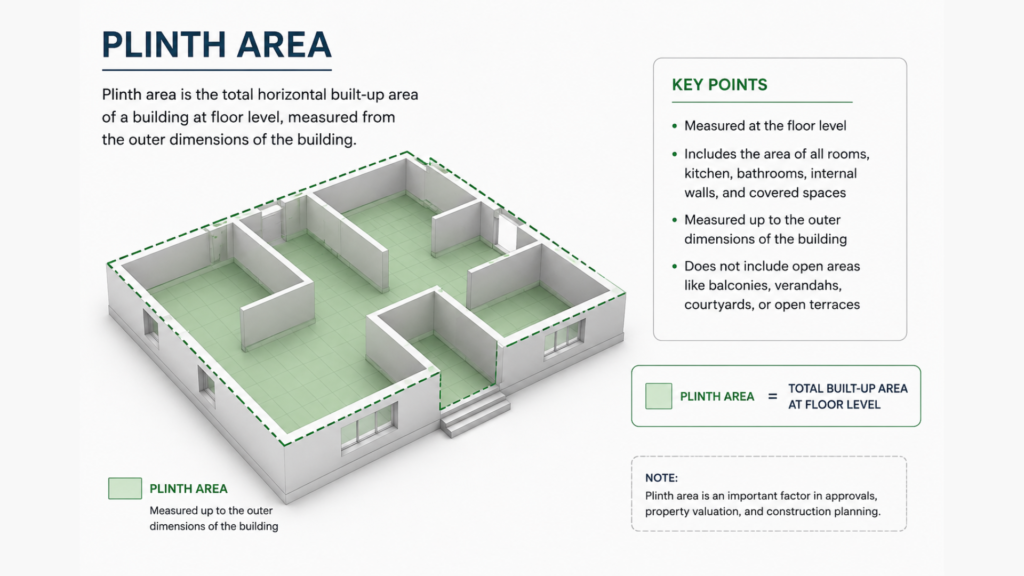
Plinth area refers to the total covered built-up area measured at the floor level of a building. More precisely, it is the area measured from the outer face of the external walls on every side.
The Bureau of Indian Standards (BIS) defines it in IS 3861:2002 the Indian Standard Method of Measurement of Plinth, Carpet and Rentable Areas of Buildings as:
“The built-up covered area measured at the floor level of the basement or of any storey.”
In everyday language, plinth area is the horizontal footprint of the building everything that is covered and enclosed, measured at each floor level from the outside edges of the walls.
Plinth area is also commonly called built-up area. Both terms are often used interchangeably in India, though built-up area tends to be used for apartments and builder floors, while plinth area is the preferred term for independent houses and villas.
Quick Definition
| Term | Simple Meaning |
|---|---|
| Plinth Area | Total covered area of the building measured from outer wall to outer wall at floor level. Includes walls, staircases, and enclosed spaces. |
| Carpet Area | Usable floor area measured from inner wall to inner wall. Excludes wall thickness, balconies, and common areas. |
| Built-Up Area | Same as plinth area in most contexts. About 10–15% more than carpet area. |
| Super Built-Up Area | Built-up area plus proportionate share of common areas like lobbies, lifts, and staircases. |
Why Does Plinth Area Matter?
Understanding the plinth area of a property or building matters in at least five practical ways:
- Construction cost estimation: Builders and civil engineers calculate approximate project costs by multiplying the plinth area by the plinth area rate (cost per square foot or square metre for similar buildings in the locality). This is called a plinth area estimate.
- Property tax assessment: Many municipal bodies in India levy property tax based on the plinth area or built-up area of the property.
- Building plan approval: Local development authorities use the plinth area to verify Floor Area Ratio (FAR) and Floor Space Index (FSI) compliance before approving a building plan.
- Legal documentation: Sale deeds, registration documents, and loan sanction letters from banks often mention the plinth area as the basis for property valuation.
- Home loan eligibility: Financial institutions consider the plinth area when evaluating a property for a loan against property or home loan.
Simply put, if you are buying, building, or borrowing against property you need to know the plinth area.
What is Included in Plinth Area?
As per IS 3861:2002, the following elements must be included when calculating plinth area:
- Internal walls and external walls measured at each floor level, excluding plinth offsets
- Load-bearing columns up to the outer face of cladding
- Covered staircases and staircase rooms at every floor level
- Lift wells and air-conditioning ducts included at each floor level
- Internal service shafts for sanitary installations, garbage chutes, telecom, electrical, and firefighting systems, provided they do not exceed 2 sq m individually
- Covered verandahs, porches, and balconies that are structurally attached and roofed
- Mezzanine floors if they meet habitable room standards
- Barsati or habitable rooms at terrace level
- Covered parking if structurally attached to the main building
A useful memory rule: if an area is roofed, enclosed, and measured at floor level, it is almost certainly part of the plinth area.
What is Excluded from Plinth Area?
The following are specifically excluded from plinth area under IS 3861:2002:
- Open terraces, open courtyards, and open balconies (unroofed or open to the sky)
- Architectural projections sun breakers, box louvres, flower pot slabs, cornices
- Loft areas
- Internal sanitary shafts exceeding 2 sq m
- Spiral staircases or external service staircases
- Elements projecting above terrace level domes, towers, turrets, water tanks on terrace
- Open parking areas not enclosed by walls
- Additional sitting floors in auditoriums, theatres, and assembly halls
Note: Semi-open areas like open verandahs follow partial inclusion rules typically 50% of the unprotected portion and 100% of the portion covered by a projection above.
Plinth Area: Inclusions and Exclusions at a Glance
| Included in Plinth Area ✅ | Excluded from Plinth Area ❌ |
|---|---|
| Internal and external walls | Open terraces and open courtyards |
| Covered staircases | Loft areas |
| Lift wells and AC ducts | Sun breakers and decorative projections |
| Attached covered verandahs | Spiral staircases / external service stairs |
| Covered balconies (roofed) | Open balconies (unroofed) |
| Mezzanine floors (habitable) | Projections above terrace level (towers, domes) |
| Service shafts up to 2 sq m | Sanitary shafts exceeding 2 sq m |
| Covered parking (attached) | Open parking areas |
How to Calculate Plinth Area: Formula and Step-by-Step Method
The plinth area formula is straightforward for rectangular buildings:
Plinth Area = Length (outer dimension) × Breadth (outer dimension)
For buildings with multiple shapes, rooms, or projections, the plinth area is calculated for each section and summed. Here is the step-by-step approach:
- Step 1: Measure the outer length and breadth of the building at the plinth level from the external wall faces.
- Step 2: For irregular buildings, divide the plan into rectangles or regular shapes. Calculate the area of each section.
- Step 3: Add areas of all attached covered structures (verandahs, garages, covered parking) as applicable.
- Step 4: Apply the IS 3861:2002 inclusion and exclusion rules to each section.
- Step 5: Sum all included areas. For multi-storey buildings, calculate the plinth area of each floor separately — they may differ if upper floors have different layouts.
Measurement precision: As per IS 3861:2002, dimensions must be recorded to the nearest 0.01 m (or nearest 1 inch in the feet system). Areas should be rounded to 0.01 m².
Worked Example: Plinth Area Calculation for a House
Let us calculate the plinth area for a simple independent house:
| Element | Length | Breadth | Area | Inclusion Rule |
|---|---|---|---|---|
| Main building (outer dimensions) | 12.00 m | 9.00 m | 108.00 sq m | 100% included |
| Covered verandah (attached, roofed) | 4.00 m | 2.50 m | 10.00 sq m | 100% included |
| Open terrace (open to sky) | 3.00 m | 2.00 m | 6.00 sq m | Excluded |
| Open car parking | 5.00 m | 2.50 m | 12.50 sq m | Excluded |
Plinth Area = 108.00 + 10.00 = 118.00 sq m
The open terrace and open parking are excluded as they are not covered and enclosed.
Using Plinth Area for a Construction Cost Estimate
Once you have the plinth area, you can estimate the construction cost:
Building Cost = Plinth Area × Plinth Area Rate
Example: If the plinth area is 118 sq m and the local plinth area rate is ₹20,000 per sq m, the estimated building cost is:
118 × ₹20,000 = ₹23,60,000 (approximately ₹23.6 lakhs)
This is a preliminary or approximate estimate used for budget planning, not a final project cost. The CPWD (Central Public Works Department) releases updated plinth area rates annually for different building types and regions. For 2025–26, standard residential rates (RCC framed construction, floor height 3.35 m) are approximately ₹19,000 per sq m, with private residential projects often ranging from ₹1,500 to ₹3,000 per sq ft depending on finish quality.
Plinth Area vs Carpet Area vs Built-Up Area: What’s the Difference?
Confusion between these three terms is extremely common — especially for homebuyers. Here is the clearest comparison:
| Area Type | What it Measures | Includes Walls? | Includes Balconies? | Typical Relation |
|---|---|---|---|---|
| Carpet Area | Net usable floor space what a carpet can cover. Inner wall to inner wall. | No | No (as per RERA) | Smallest (approx. 70% of built-up area) |
| Plinth Area / Built-Up Area | Total covered area at floor level outer wall to outer wall. Includes wall thickness. | Yes | Yes (if covered/attached) | 10–15% more than carpet area |
| Super Built-Up Area | Built-up area plus proportionate share of common areas (lobby, lift, staircase, corridor). | Yes | Yes | 25–50% more than carpet area |
Is Plinth Area the Same as Built-Up Area?
Yes in most practical and legal contexts, plinth area and built-up area mean the same thing. Both refer to the total covered area of the property including walls. The distinction, where it exists, is primarily in usage: plinth area tends to be used for independent houses and villas; built-up area is used for apartments.
However, some sources make a subtle distinction: they define built-up area as slightly larger than plinth area, by including additional spaces like covered balconies and terraces that the plinth area of the ground floor might not capture. Always check with the local building authority or developer for the precise definition used in your context.
RERA and Carpet Area
The Real Estate (Regulation and Development) Act, 2016 (RERA) made it mandatory for all developers to quote and sell apartments based on carpet area, not super built-up area. This was a major consumer protection measure, as builders previously quoted super built-up areas inflating the apparent size and making it harder for buyers to compare properties.
When a builder gives you a carpet area under RERA, it includes the area covered by internal partition walls but excludes external walls, service shafts, balconies, and verandahs. Understanding this distinction ensures you know exactly how much usable space you are paying for.
Plinth Area and Floor Area Ratio (FAR / FSI)
Floor Area Ratio (FAR) — also called Floor Space Index (FSI) is a key regulatory concept in urban planning. It determines how much total built-up area can be constructed on a given plot, expressed as a ratio:
FAR / FSI = Total Plinth Area of All Floors ÷ Plot Area
Example: If the FAR permitted is 2.0 and the plot area is 300 sq m, the maximum permissible plinth area (across all floors combined) is 300 × 2 = 600 sq m.
Local development authorities like MUDA (Mysuru Urban Development Authority), BBMP, GHMC, and others specify maximum FAR/FSI values for different zones. Construction beyond the permitted FAR is illegal, regardless of how many floors are built.
This is why plinth area calculation is critical for compliance it is the unit of measurement used to check FAR compliance.
Common Mistakes in Plinth Area Calculation
Even experienced builders and architects make errors in plinth area calculations. Here are the most frequent mistakes to avoid:
- Ignoring wall thickness: Using inner dimensions instead of outer dimensions. Remember plinth area is measured from outer face to outer face.
- Excluding internal partition walls: These contribute to total wall area and should be included.
- Mismeasuring irregular or L-shaped buildings: Always decompose irregular plans into regular rectangles or shapes and calculate each section individually.
- Confusing covered and uncovered areas: An open balcony (no roof) is excluded. A covered balcony (roofed, attached) is included. The difference can be a few sq m which affects both cost estimates and regulatory compliance.
- Not calculating each floor separately: In multi-storey buildings, the plinth area of each floor may differ if the floor layout changes. Estimate separately for each storey.
- Using plinth area interchangeably with floor area: Floor area = Plinth area minus wall area. It is a smaller measurement, used for interior space planning, not cost estimation.
Frequently Asked Questions About Plinth Area
Is plinth area always larger than carpet area?
Yes. Plinth area is always larger than carpet area because it includes the thickness of all external and internal walls, in addition to the usable floor space. Typically, the plinth area of a building is 10–20% greater than its carpet area.
Do balconies count in plinth area?
It depends on whether the balcony is covered. A covered balcony with a structural roof is included in plinth area. An open balcony exposed to the sky is excluded. For semi-covered balconies, IS 3861:2002 applies partial inclusion rules typically 100% for the portion protected by a projection and 50% for the unprotected portion.
Does parking area count in plinth area?
Only covered, enclosed parking that is structurally attached to the building is included in plinth area. Open parking a slab area accessible for cars but without walls or a roof is excluded.
What is the plinth area rate?
The plinth area rate is the cost per square metre (or per square foot) to construct a similar building in the same locality with similar specifications. It is used to calculate a quick preliminary cost estimate. CPWD revises these rates annually. For 2025–26, standard residential RCC construction is approximately ₹19,000 per sq m. Private market rates range from ₹1,500 to ₹3,000 per sq ft for residential construction, varying by city and finish quality.
Is plinth area required for building plan approval?
Yes. Building plan approval from local municipal or development authorities requires that the total plinth area across all floors remains within the FAR/FSI limit for the plot and zone. Architects and civil engineers must clearly indicate the plinth area of each floor in the submitted building drawings.
Is the plinth area mentioned in the sale deed?
For independent houses and villas, sale deeds typically mention the plinth area. For apartments, RERA mandates that the carpet area be stated prominently in the agreement of sale. Some documents mention both. Always verify the measurement type mentioned in your sale agreement before signing.
Key Takeaways
- Plinth area is the total covered built-up area of a building measured at floor level from the outer face of external walls.
- It is defined under IS 3861:2002 and includes internal walls, external walls, covered staircases, lift wells, covered balconies, and utility shafts up to 2 sq m.
- Open terraces, open balconies, open parking, lofts, and architectural projections are excluded.
- Plinth area = Carpet area + Wall area (both internal and external) + covered balconies and utility shafts.
- In most practical contexts, plinth area and built-up area mean the same thing.
- RERA mandates that apartments be sold on carpet area basis. Plinth area is still used for independent houses, cost estimation, and regulatory approval.
- Construction cost estimation: Building Cost = Plinth Area × Plinth Area Rate.
- Plinth area is the basis for FAR/FSI compliance checks during building plan approval.
Whether you are reviewing building plans, getting a construction estimate, or verifying the size of a property you want to purchase understanding the plinth area meaning gives you the clarity to make better decisions. It is not just a technical term; it is a financial and legal measurement that affects costs, taxes, approvals, and the actual space you get.
If you are building a home or a commercial property in Mysore or Karnataka, consulting with a civil engineer or registered architect before submitting building plans is strongly advisable particularly to ensure FAR compliance with MUDA or the local development authority.