
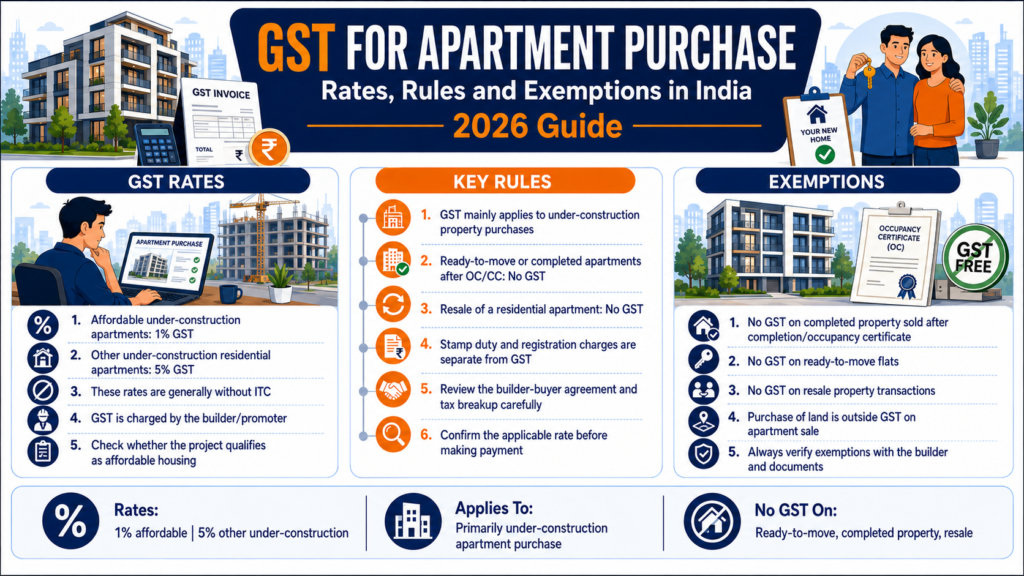
The single most important rule to understand about GST for apartment purchase in India is also the one most buyers get wrong: GST is charged only on under-construction flats, never on a ready-to-move-in home that already has its completion certificate. Get that one distinction right and most of the confusion around property tax disappears.
This 2026 guide breaks down exactly what you pay, when you pay it, and when you legally owe nothing at all. Whether you are buying your first flat in Mysuru or comparing an under-construction tower against a ready home, here is everything you need before you sign the agreement.
GST for apartment purchase at a glance (2026)
As of 2026, GST on residential real estate is charged at two headline rates, both without input tax credit (ITC). These rates have applied since 1 April 2019 and were left unchanged by the GST 2.0 rate revision of September 2025.
| Type of property | GST rate (2026) | ITC available? |
|---|---|---|
| Affordable housing (under construction) | 1% | No |
| Other residential flats (under construction) | 5% | No |
| Ready-to-move-in flat (with OC/CC) | 0% (exempt) | Not applicable |
| Resale flat | 0% (exempt) | Not applicable |
| Plot / land only | 0% (exempt) | Not applicable |
| Commercial unit (under construction) | 12% | Yes (for GST-registered buyers) |
In short: if the apartment is under construction, expect 1% or 5% GST. If it already has an Occupancy or Completion Certificate, or you are buying a plot or a resale flat, no GST applies at all.
When does GST apply on a flat purchase?
Under India’s GST framework, constructing a building is treated as a supply of construction service, and services are taxable. Buying land or a finished building, on the other hand, is a transfer of immovable property, which is kept outside GST under Schedule III of the CGST Act, 2017.
So the status of the apartment at the time you pay decides everything:
- Under-construction flat — the builder is supplying you a construction service. GST is charged at 1% or 5%.
- Ready-to-move-in flat — once the builder has the Completion Certificate (CC) or Occupancy Certificate (OC), the sale is a transfer of property. No GST.
The timing of your agreement matters. If the OC is issued before your sale agreement is executed, GST generally does not apply. If you book while construction is ongoing, GST applies on the payments made before the certificate is issued. This is closely tied to the project’s approval trail, from the commencement certificate at the start to the completion certificate at the end.
GST on flat purchase: current rates explained
The two residential rates are simple on the surface, but two details trip up most buyers.
The 1% rate (affordable housing)
Under-construction apartments that qualify as affordable housing attract just 1% GST, with no input tax credit. This concessional rate supports the government’s “Housing for All” goal.
The 5% rate (other residential flats)
Every other under-construction residential apartment, from mid-segment to luxury, attracts 5% GST without ITC.
An important point on how the rate is applied: government rules require the builder to notionally treat one-third of the total price as land value, which is GST-exempt, and charge GST only on the remaining two-thirds. The headline 1% and 5% figures you see are already the abated rates, so 5% is applied to the full price shown on your cost sheet, not on top of a separate land deduction. You do not need to do that math yourself.
Because ITC is not available on residential purchases booked after April 2019, the GST you pay is a straight cost. There is no offset or refund for the buyer. This makes it very different from TDS on buying property, which is an advance tax credited to the seller and is a separate obligation altogether.
GST on flats below 45 lakhs: the affordable housing rule
This is where gst on flats below 45 lakhs gets misunderstood. A price under ₹45 lakh alone does not make a flat “affordable” for GST. Two conditions must be satisfied at the same time, as defined by the GST Council:
- Price: the gross amount charged by the builder is ₹45 lakh or less; and
- Carpet area: up to 60 square metres in metro cities, or up to 90 square metres in non-metro cities.
Miss either condition and the flat falls into the 5% bracket, even if it is priced below ₹45 lakh.
For buyers in Mysuru, this works in your favour. Mysuru is a non-metro city, so the carpet-area limit is the more generous 90 square metres (roughly 968 sq ft). The GST Council treats only Bengaluru, Chennai, Delhi-NCR, Hyderabad, Kolkata and Mumbai (MMR) as metros. That means a reasonably spacious sub-₹45 lakh apartment in Mysuru can still qualify for the 1% rate where the same flat in Bengaluru might not.
Because the definition hinges on carpet area, it pays to know exactly what that means and how it differs from built-up and super built-up area. Our guide on carpet area, plinth area and built-up area explains how to read the number that actually decides your GST bracket.
GST on property purchase: how to calculate it (worked examples)
Calculating gst on property purchase is straightforward once you know the rate. Apply the rate to the agreement value shown on your cost sheet.
| Scenario | Flat price | Category | GST rate | GST payable |
|---|---|---|---|---|
| Sub-₹45 lakh flat in Mysuru, 88 sq m carpet area | ₹40,00,000 | Affordable | 1% | ₹40,000 |
| Flat priced above the affordable cap | ₹80,00,000 | Non-affordable | 5% | ₹4,00,000 |
| Ready-to-move flat with OC | ₹80,00,000 | Exempt | 0% | ₹0 |
Notice the gap. The difference between a 1% and a 5% classification on an ₹80 lakh flat is nearly ₹3.2 lakh, which is exactly why confirming the affordable-housing status in writing matters so much.
When GST does NOT apply on a house purchase
Knowing when you owe gst on house purchase is only half the story. Here are the situations where you legally pay nothing:
- Ready-to-move-in flats that already hold a valid Occupancy or Completion Certificate. These are treated as completed goods, not a service.
- Resale flats. A resale of a completed home by an individual is outside GST. You will still pay stamp duty and registration.
- Plots and land. The sale of land is outside GST under Schedule III. A CBIC circular dated 3 August 2022 confirmed that even developed plots with basic infrastructure do not attract GST. If you are weighing a plot or site in Mysore against an apartment, this is a genuine cost difference to factor in.
One caution: a flat that is 90% complete but has no OC or CC can still be treated as under construction and taxed. It is the certificate, not the physical progress, that ends GST liability.
GST vs stamp duty and registration: they are separate
A frequent mistake is assuming GST replaced stamp duty. It did not. Stamp duty and registration charges are levied by the state government and sit entirely outside the GST framework. On an under-construction flat, you may pay all three: GST to the builder, plus stamp duty and registration to the state.
These state charges apply even on GST-exempt ready and resale properties, so budget for them separately. If you are buying in Karnataka, our walkthrough on paying property tax online covers the recurring civic charges that come after possession, which are again distinct from both GST and stamp duty.
What else attracts GST when you buy an apartment?
GST does not stop at the base price of the flat. Any charge that forms part of the same purchase agreement is taxed at the same rate as the apartment:
- Covered/stilt car parking, clubhouse membership, preferential location charges (PLC) and amenity charges billed by the builder attract GST at the flat’s rate. If parking is bundled into your booking, understand how it is treated. Our guide to stilt parking rules for apartment buyers explains the details.
- Society maintenance collected by the Residents’ Welfare Association is generally exempt up to ₹7,500 per month per member. Above that threshold, 18% GST applies (and only where the RWA’s annual turnover crosses the registration limit).
A buyer’s GST checklist before you sign
Before you commit to an under-construction apartment, confirm these points in writing:
- OC/CC status. Ask whether the project has its Occupancy or Completion Certificate. If it does and it predates your agreement, question any GST being charged.
- Which rate applies. Get the builder to state 1% or 5% in the cost sheet, and the reason for the classification.
- Affordable-housing proof. If you are told the rate is 1%, verify both the ₹45 lakh price and the carpet-area limit.
- RERA registration. A registered project confirms the rate scheme and the approval trail.
- Agreement value. GST is charged on the value in your sale agreement. Knowing the difference between a sale and an agreement to sell helps you read exactly what you are being taxed on.
For the official position, the GST Council’s FAQs on the real estate sector and the CBIC are the authoritative sources. When rates or thresholds change, these are the documents that carry legal force.
Frequently asked questions
Is GST applicable on buying a flat in 2026?
Only if the flat is under construction. GST is 1% for affordable housing and 5% for other residential flats, both without input tax credit. Ready-to-move-in flats with an Occupancy or Completion Certificate, and resale flats, are exempt from GST.
What is the GST rate on flats below 45 lakhs?
A flat below ₹45 lakh gets the 1% affordable-housing rate only if it also meets the carpet-area limit: 60 square metres in metros or 90 square metres in non-metros like Mysuru. If it misses the area limit, the 5% rate applies despite the lower price.
Do I pay GST on a ready-to-move apartment?
No. A ready-to-move-in apartment that already holds a valid Occupancy or Completion Certificate is treated as a completed property and is exempt from GST. You still pay stamp duty and registration charges to the state government.
Can I claim input tax credit (ITC) on my flat purchase?
No. Since April 2019, ITC is not available to residential buyers. The 1% and 5% rates are both without ITC, so the GST you pay is a straight cost with no offset or refund. ITC only applies to GST-registered buyers of commercial property.
Is GST charged on stamp duty and registration?
No. Stamp duty and registration are state levies and sit outside GST. On an under-construction flat you pay GST to the builder plus stamp duty and registration to the state. These are three separate charges, not one.
Does GST apply to a resale flat or a plot?
No. Resale of a completed flat by an individual is exempt, as it is a transfer of immovable property. The sale of land or a plot is also outside GST, confirmed by a CBIC circular of August 2022, even for developed plots with basic infrastructure.
Buying an apartment in Mysuru? Buy with clarity.
GST is just one line in a much longer due-diligence list. At Elite Build Infra Tech, every property we recommend is checked for legal clarity, approval status and the correct tax treatment before it ever reaches you, so there are no surprises at the cost sheet. Explore our verified apartments in Mysore or browse the full range of Elite Build projects to find a home that is right on paper and on the ground.
About the author: This guide was prepared by the Elite Build Infra Tech editorial team, a Mysuru-based real estate consultancy focused on transparent, legally verified property transactions. Our content is reviewed for accuracy against current GST Council and CBIC guidance. This article is for general information only and is not tax or legal advice; consult a qualified chartered accountant or the relevant authority before making a property purchase, as rates and thresholds can change.
Last updated: July 2026.