
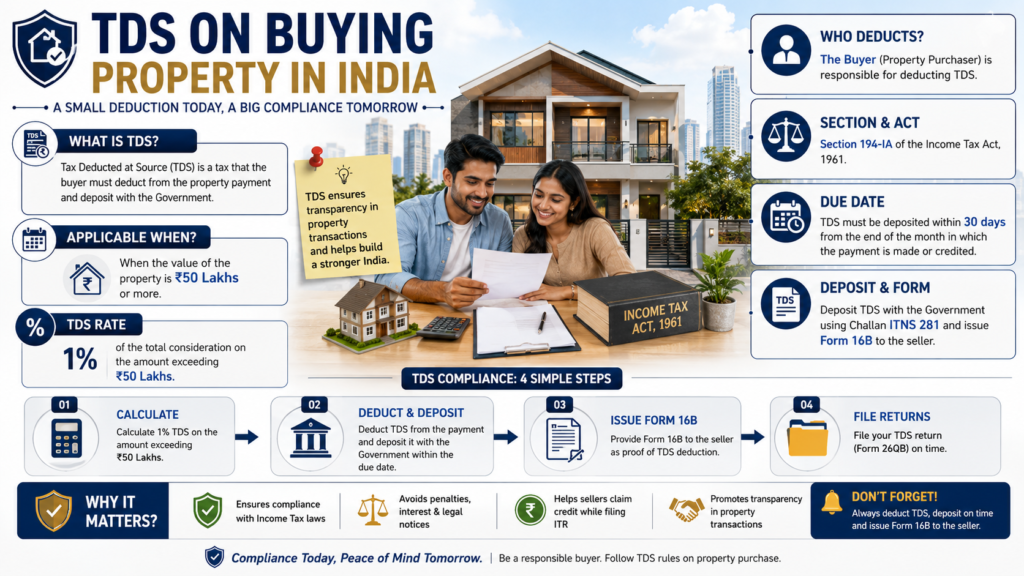
TDS on buying property is one of those rules that surprises first-time buyers at the worst moment, usually just before registration. If you are purchasing a flat, house, or plot in India and the price is high enough, the law makes you, the buyer, responsible for deducting a small slice of tax and paying it to the government. Get it right and the deal closes smoothly. Get it wrong and you can face interest, late fees, and a default notice months later.
This guide explains TDS on property purchase in plain language: what TDS means, the 1% rate, the section that governs it, how to pay TDS on purchase of property step by step, the special rules for buying from an NRI, and what happens if you miss it.
Disclaimer: This article is general information, not tax or legal advice. Tax rules and forms change. Confirm the current process on the income tax e-filing portal or with a qualified chartered accountant before your transaction.
What Is TDS on Buying Property?
TDS stands for Tax Deducted at Source. It is a system where tax is collected at the moment a payment is made, rather than later. The TDS full form in construction or property is identical: tax is simply deducted at source from a payment.
In the context of property, TDS on buying property means the buyer must deduct a percentage of the purchase price and deposit it directly with the Income Tax Department, paying only the balance to the seller. This is separate from other costs of buying, such as stamp duty, registration charges, or GST on under-construction homes. Those are different heads of tax on property purchase; TDS is its own obligation that sits on the buyer.
The purpose is straightforward. By capturing 1% at source, the government creates a clear record of high-value property deals and ensures the seller cannot avoid reporting the sale.
TDS on Property Purchase Above 50 Lakhs Section 194-IA
The rule on TDS on immovable property purchase comes from Section 194-IA of the Income Tax Act, in force since 2013. The essentials are easy to remember.
- Threshold: TDS applies when the consideration, or the stamp duty value, of the property is ₹50 lakh or more.
- Rate: 1% TDS on property, calculated on the higher of the sale consideration or the stamp duty value.
- On the full amount: Once you cross ₹50 lakh, the 1% applies to the entire value, not just the part above ₹50 lakh.
- Who deducts: The buyer (transferee). The seller must be a resident for this section to apply.
- No PAN of seller: If the seller does not provide a valid PAN, the rate jumps to 20%.
So if you buy a flat for ₹75 lakh, the 1% TDS on flat purchase is ₹75,000. You pay the seller ₹74,25,000 and deposit ₹75,000 with the government. The same logic covers tds on home purchase, tds on purchase of land (any non-agricultural land), and commercial property. The TDS for flat purchase, a house, or a plot all follow this single 1% rule.
Buyers often see this described as TDS on sale of property as well. It is the same deal viewed from the seller’s side, governed by the same TDS on sale of property section, Section 194-IA, so the sale of property TDS rate and the purchase rate are one and the same. In short, the TDS rate on sale of property is also 1%.
One important update applies from 1 October 2024. Where there is more than one buyer or more than one seller, the ₹50 lakh threshold is tested on the aggregate consideration for the whole property, not on each person’s share. A joint purchase of ₹90 lakh by two buyers cannot escape TDS just because each share looks like ₹45 lakh. You can confirm the official position on the Income Tax Department page on TDS for purchase of immovable property.
When Does TDS on Property Apply, and When Not?
The rule covers the purchase of immovable property such as a flat, apartment, independent house, building, or non-agricultural plot, where the value is ₹50 lakh or more. It applies whether you pay in one shot or in instalments.
If you pay in instalments, you deduct purchase TDS on each instalment as it is paid, not only at the end. The two situations where TDS on property payment does not apply are when the value is below ₹50 lakh, and when the land is rural agricultural land, which Section 194-IA specifically excludes.
How to Pay TDS on Purchase of Property: Step by Step
Here is how to deduct TDS on purchase of property and complete the payment correctly. The good news is you do not need a TAN. Your PAN, and the seller’s PAN, are enough. If you are wondering how to pay TDS on property purchase, or simply how to pay TDS for property, the steps below are the same. Paying TDS on property is the buyer’s job, and the TDS payment for property purchase must reach the government on time. A clear walkthrough is also available on ClearTax’s guide to filing TDS on property.
- Deduct at the right time. Deduct the 1% when you credit the amount to the seller or actually pay it, whichever is earlier. For instalments, deduct on each one.
- Fill Form 26QB. This is how to file TDS on purchase of property. Go to the income tax e-filing portal, open Form 26QB (the challan-cum-statement), and enter the buyer’s and seller’s PAN, property details, value, and the TDS amount.
- Make the payment. Pay TDS on property online through the portal’s e-pay tax facility. This step is the actual payment of TDS on property and generates an acknowledgement.
- Mind the deadline. You must deposit the TDS within 30 days from the end of the month in which the deduction was made. Making the TDS payment on property within this window is how to deposit TDS on property purchase on time and avoid penalties.
- Keep proof. Save the Form 26QB acknowledgement and check that the entry appears in your Form 26AS.
If there are multiple buyers or sellers, a separate Form 26QB is generally filed for each buyer-seller combination for that person’s share, even though the threshold is judged on the total property value.
Form 16B: The TDS Certificate You Give the Seller
After the property TDS payment is done, the buyer must download Form 16B from the TRACES portal and hand it to the seller. Form 16B is the TDS certificate, the seller’s proof that the 1% was actually deposited with the government. It must be issued within 15 days of the Form 26QB due date.
This matters to the seller because, without it reflecting in their records, they cannot take credit for the TDS when filing their income tax return and could end up paying tax twice on the same sale.
TDS When Buying Property From an NRI: A Different Rule
Section 194-IA, with its simple 1% and Form 26QB, applies only when the seller is a resident. If you are buying property from a Non-Resident Indian, a completely different and stricter rule applies under Section 195.
For an NRI seller, TDS is deducted at capital gains tax rates, not a flat 1%. Long-term capital gains are currently taxed at 12.5% plus applicable surcharge and cess, and short-term gains are taxed at higher slab rates. The buyer also needs a TAN for this transaction and files Form 27Q instead of Form 26QB. Because the amounts and compliance are far heavier, always involve a chartered accountant when buying from an NRI seller.
Who Can Claim TDS on Purchase of Property?
This is a common point of confusion. The buyer does not claim the TDS; the buyer only deducts and deposits it. The person who can claim TDS on purchase of property is the seller, by taking credit for the deposited amount against their tax liability when filing their income tax return.
The only situation where a buyer gets money back is if a deal is cancelled after TDS was paid, in which case a refund can be sought through the prescribed online process.
TDS Default Notice and Penalties for Property Purchase
The Income Tax Department receives data on every registered high-value sale from the sub-registrar through the Annual Information Return. If you buy a property above ₹50 lakh and no Form 26QB is filed, the system flags it and a tds default notice for property purchase is issued to the buyer. The costs of getting this wrong add up quickly.
| Default | Consequence |
|---|---|
| TDS not deducted | Interest of 1% per month under Section 201(1A) |
| TDS deducted but not deposited | Interest of 1.5% per month until paid |
| Form 26QB filed late | Late fee of ₹200 per day under Section 234E, capped at the TDS amount |
| Failure to file or serious default | Penalty up to ₹1,00,000 under Section 271H |
The simplest protection is to treat the TDS step as part of registration itself, not an afterthought.
A Note on 2026: New Income-tax Act
The familiar framework of Section 194-IA, Form 26QB, and Form 16B has governed TDS on property for over a decade. Under the new Income-tax Act, 2025, which applies to transactions from 1 April 2026, the substance stays the same: the buyer deducts roughly 1% on a resident-seller property purchase above ₹50 lakh, deposits it, and issues a certificate to the seller. Only some form names and section references are being updated. Because this transition is recent, always check the current form on the income tax e-filing portal at the time of your purchase, or ask your CA, so you file the right one.
TDS on Buying Property: Quick Summary
| Point | Detail |
|---|---|
| Governing section | Section 194-IA (resident seller) |
| Threshold | ₹50 lakh or more (aggregate, from 1 Oct 2024) |
| Rate | 1% of the higher of consideration or stamp duty value |
| Who deducts | The buyer |
| Form to file | Form 26QB (challan-cum-statement) |
| Certificate to seller | Form 16B |
| Deposit deadline | Within 30 days from end of month of deduction |
| No seller PAN | Rate becomes 20% |
| NRI seller | Section 195, higher rates, TAN and Form 27Q needed |
| Agricultural land | Exempt |
How This Fits Into Your Property Purchase
TDS is one step in a larger chain of doing a purchase correctly. The sale itself is governed by the Transfer of Property Act 1882, and the document that records it is your sale deed, explained in our guide on conveyance deed vs sale deed. For the full set of paperwork involved in a transfer, see the main types of property deeds in India.
After registration and TDS, complete your mutation in property so government records carry your name, and in Bengaluru or Mysuru confirm the A Khata or B Khata status, which affects loans and resale. Understanding all of this also protects your broader right of property as an owner.
This is why buying from a transparent developer matters. At Elite Build, every plot, villa, and apartment is legally verified with a clear title and complete documentation, so the value, stamp duty position, and paperwork you need for TDS are clear from the start. Explore our verified properties in Mysore when you are ready to buy with confidence.
Frequently Asked Questions
What is the TDS rate on purchase of property in India?
The TDS rate is 1% of the sale consideration or stamp duty value, whichever is higher, for resident sellers, when the property value is ₹50 lakh or more. If the seller does not provide a PAN, the rate rises to 20%.
How do I pay TDS on purchase of property?
Deduct 1% at the time of payment to the seller, then file Form 26QB on the income tax e-filing portal using both PANs, pay the TDS online, and deposit it within 30 days from the end of the month of deduction. Finally, download Form 16B from TRACES and give it to the seller.
Is TDS applicable on property below 50 lakh?
No. TDS under Section 194-IA applies only when the consideration or stamp duty value is ₹50 lakh or more. Below that, no TDS is required, although other costs like stamp duty still apply.
Who can claim TDS on purchase of property?
The seller claims the credit for the deducted TDS when filing their income tax return. The buyer only deducts and deposits it; a buyer can seek a refund only if the deal is cancelled after TDS was paid.
What is the TDS rule on sale of property by an NRI?
When the seller is an NRI, Section 194-IA does not apply. TDS is deducted under Section 195 at capital gains tax rates, which are far higher than 1%, the buyer needs a TAN, and Form 27Q is filed. Professional advice is strongly recommended.
What happens if I do not pay TDS on a property purchase?
The Income Tax Department can issue a default notice based on registrar data. You may face interest of 1% or 1.5% per month, a late fee of ₹200 per day for delayed Form 26QB, and a penalty of up to ₹1,00,000.
Is TDS applicable on purchase of land?
Yes, on non-agricultural land worth ₹50 lakh or more. Rural agricultural land is specifically exempt from TDS under Section 194-IA.
The Bottom Line
TDS on buying property is simple once you see the pattern: if a resident seller’s property crosses ₹50 lakh, deduct 1%, pay it through Form 26QB within the deadline, and hand the seller Form 16B. The traps are forgetting the aggregate threshold on joint deals, missing the NRI rule, and treating TDS as optional. Build the TDS step into your registration checklist, keep the proofs, and your purchase stays clean and litigation-free.
About the author: The Elite Build Editorial Team writes practical, well-researched guides on property law, taxation, documentation, and real estate investment in Karnataka. Elite Build Infra Tech is a Mysuru-based developer focused on legally verified, clear-title plots, villas, and apartments. This guide was last updated in June 2026.