
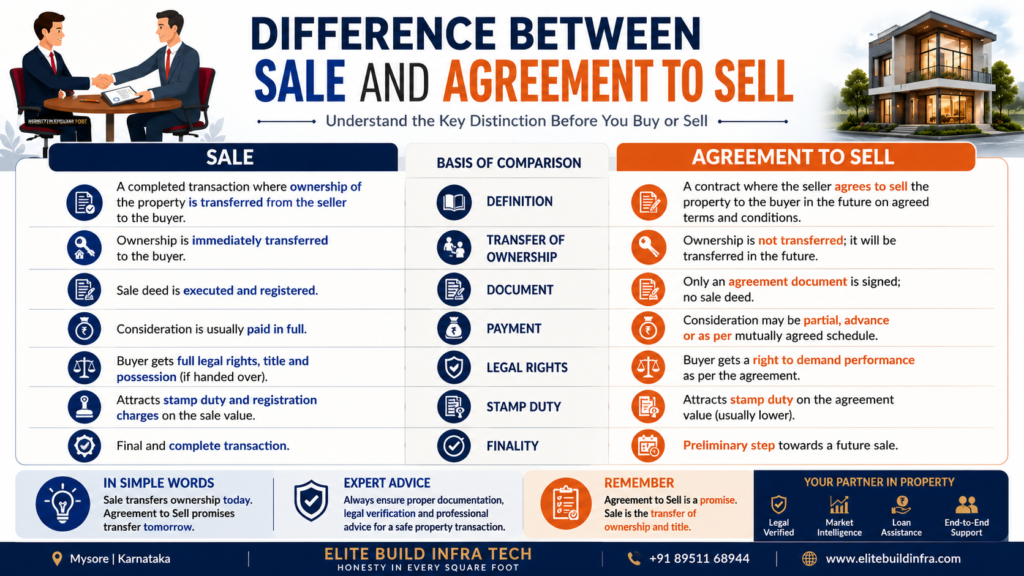
The difference between sale and agreement to sell is one of the most useful distinctions in commercial and property law, and also one of the most misunderstood. Both look similar on paper. Both involve a seller, a buyer, goods or property, and a price. Yet they sit at opposite ends of one timeline: a sale transfers ownership now, while an agreement to sell only promises to transfer it later. That single gap decides who owns the asset, who bears the risk, and who can sue whom if things go wrong.
This guide explains the difference between sale and agreement to sell in plain language, starting with the contract of sale under the Sale of Goods Act, 1930, and then bridging to what it means for property buyers, where the same idea appears as a sale agreement and sale deed.
Disclaimer: This article is general information, not legal advice. For a specific transaction or dispute, consult a qualified lawyer.
The Short Answer: Difference Between Sale and Agreement to Sell
In a sale, ownership passes from seller to buyer immediately. In an agreement to sell, ownership passes at a future time or once certain conditions are met. A sale is a completed (executed) contract; an agreement to sell is a contract still waiting to be completed (executory). Everything else, who carries the risk, what remedy each side has, follows from this one difference.
What Is a Contract of Sale?
Before you can distinguish between sale and agreement to sell, it helps to know the umbrella term that covers both. Under Section 4 of the Sale of Goods Act, 1930, a contract of sale of goods is a contract whereby the seller transfers or agrees to transfer the property in goods to the buyer for a price.
That contract of sale meaning is deliberately broad. The phrase “contract of sale” is generic: it includes both an outright sale and an agreement to sell. So the simplest sale contract definition is an agreement to transfer ownership of goods for money, which then splits into two forms depending on when ownership actually moves. Whether you call it a contract of sale agreement or simply a sales contract, the legal source is the same, set out in the Sale of Goods Act, 1930 bare Act. When people ask what is a contract of sale or what is contract of sale, this is the answer: it is the parent category, and a sale or an agreement to sell are its two children.
What Is a Sale?
A sale is the form of a contract of sale where the property in the goods is transferred from the seller to the buyer at the time of the contract. It is an executed contract, meaning the main act, the transfer of ownership, has already happened.
Because ownership has moved, the buyer now carries the risk. If the goods are damaged or destroyed after the sale, the loss falls on the buyer, following the rule that the thing is lost to its owner. A sale typically involves existing, specific goods that are ready for delivery.
What Is an Agreement to Sell?
An agreement to sell is the form where the transfer of ownership is to take place at a future time, or subject to a condition being fulfilled. It is an executory contract: a promise that the sale will happen later. The law is clear that an agreement to sell becomes a sale once the time elapses or the conditions are satisfied.
So what is a sale agreement in everyday language? It is a binding promise to complete a sale on agreed terms. Until that moment arrives, the seller still owns the goods and still carries the risk. This is also why people search for what is sale agreement or what is a sales agreement: they are describing this same executory step that sets up a future sale.
Difference Between Sale and Agreement to Sell: Full Comparison
The table below lays out the difference between sale and agreement to sale side by side, so you can distinguish between sale and agreement to sell at a glance.
| Basis | Sale | Agreement to Sell |
|---|---|---|
| Nature of contract | Executed (completed) | Executory (to be completed) |
| Transfer of ownership | Immediate | Future or conditional |
| Type of goods | Usually existing, specific goods | Often future or contingent goods |
| Who bears the risk | The buyer | The seller |
| Seller’s remedy on breach | Suit for the price | Suit for damages |
| Buyer’s right | Right against the goods themselves | Right against the seller only |
| Can the seller resell? | No, the buyer owns it | Yes, but seller is liable for damages |
| If the buyer goes insolvent | Seller must deliver and claim dividend | Seller may withhold delivery until paid |
In short, a sale gives the buyer a right in the property itself, while an agreement to sell gives only a right against the seller to complete the deal.
Difference Between Contract of Sale and Agreement to Sell
People often ask about the difference between contract of sale and agreement to sell, or the difference between contract of sale and contract to sell. The key is that these are not opposites. A contract of sale is the wider category; an agreement to sell is one type within it. So comparing them is like comparing “vehicle” with “car”. Every agreement to sell is a contract of sale, but not every contract of sale is an agreement to sell, because some are completed sales.
When you see the terms sale and agreement to sell, sell and agreement to sell, contract of sale and agreement to sell, or simply agreement to sell or sale used together, they are all pointing to this one framework: a promise to transfer versus an actual transfer.
When Does an Agreement to Sell Become a Sale?
An agreement to sell is not permanent. The law says it becomes a sale the moment the agreed time elapses or the stated conditions are fulfilled. That is the point at which ownership finally passes from seller to buyer, and the executory contract turns into an executed one.
A simple example makes it clear. If you agree today to buy goods that the seller will manufacture next month, that is an agreement to sell, because the goods do not yet exist in a deliverable state. Once they are made and ready, and the conditions in the contract are met, the same arrangement automatically ripens into a sale. The practical lesson is to know exactly which conditions trigger that switch, because until they are met, the risk and ownership stay with the seller.
Sale Agreement and Sale Deed: The Property Angle
For property buyers, the same logic appears in the difference between a sale agreement and sale deed, and getting it wrong can cost you the property. Real estate is governed by the Transfer of Property Act, 1882, not the Sale of Goods Act, but the principle mirrors it exactly.
Section 54 of the Transfer of Property Act defines a sale as a transfer of ownership for a price, made by a registered instrument for property worth ₹100 or more. The same section then says that a contract for sale, an agreement to sell, “does not, of itself, create any interest in or charge on such property.” In other words, a sale agreement is only a promise; the sale deed is what actually transfers ownership.
The Supreme Court has reinforced this firmly. In the landmark case of Suraj Lamp and Industries v. State of Haryana, the Court held that an agreement to sell, a power of attorney, or a will cannot transfer ownership of immovable property. Only a registered sale deed conveys title. The Court has reaffirmed this as recently as 2025, holding that an agreement to sell, even when the buyer has paid and taken possession, does not by itself make the buyer the owner; the only remedy is a suit for specific performance to compel a proper sale deed. You can read the exact wording in Section 54 of the Transfer of Property Act on Indian Kanoon.
| Basis | Agreement to Sell (sale agreement) | Sale Deed |
|---|---|---|
| What it is | A promise to sell in future | The actual transfer of ownership |
| Ownership | Stays with the seller | Passes to the buyer |
| Creates interest in property? | No (Section 54) | Yes |
| Registration | Not compulsory, but advisable | Compulsory |
| Remedy if broken | Suit for specific performance | Full ownership rights |
For a deeper look at the document that actually transfers title, see our guide on the conveyance deed vs sale deed, and for the wider law, our explainer on the Transfer of Property Act 1882.
Why This Matters When You Buy Property
Treating a sale agreement as if it were a completed sale is one of the most expensive mistakes in Indian real estate. Paying the full price and taking the keys on the strength of an agreement to sell, without a registered sale deed, leaves you exposed: the seller is still the legal owner and could, in theory, sell again or mortgage the property.
The safe sequence in any sale or purchase agreement is simple. Sign the agreement to sell to lock the terms, complete due diligence and payment, then execute and register the sale deed to actually transfer ownership. After that, handle your TDS on buying property if the value crosses ₹50 lakh, complete mutation in property so records carry your name, and confirm the A Khata or B Khata status. Each step protects your right of property as the new owner. For the full set of instruments involved, see the types of property deeds in India.
This is also why a transparent developer matters. At Elite Build, every plot, villa, and apartment is legally verified with a clear title, so your agreement to sell leads cleanly to a valid, registered sale deed. Explore our verified properties in Mysore when you are ready to buy with confidence.
Frequently Asked Questions
What is the main difference between sale and agreement to sell?
In a sale, ownership of the goods or property transfers to the buyer immediately. In an agreement to sell, ownership transfers at a future date or once specified conditions are met. A sale is an executed contract; an agreement to sell is an executory one.
What is a contract of sale?
A contract of sale is the general term under the Sale of Goods Act, 1930 for a contract where the seller transfers or agrees to transfer ownership of goods to the buyer for a price. It includes both an outright sale and an agreement to sell.
What is a sale agreement?
A sale agreement, or agreement to sell, is a binding promise to complete a sale on agreed terms at a future time. It does not transfer ownership by itself; it creates an obligation to do so later, enforceable through a suit for specific performance.
Does an agreement to sell transfer ownership of property?
No. Under Section 54 of the Transfer of Property Act, an agreement to sell does not create any interest in the property. As the Supreme Court held in Suraj Lamp and Industries, only a registered sale deed can transfer ownership of immovable property.
Is a sale agreement the same as a sale deed?
No. A sale agreement is a promise to sell in the future and keeps ownership with the seller. A sale deed is the registered document that actually transfers ownership to the buyer. The agreement leads to the deed, but only the deed conveys title.
Can a seller resell goods after an agreement to sell?
Yes. Because ownership has not yet passed in an agreement to sell, the seller can still resell the goods, but doing so makes the seller liable to pay damages to the original buyer for breach.
The Bottom Line
The difference between sale and agreement to sell comes down to timing of ownership: a sale moves it now, an agreement to sell moves it later. In goods, that decides who carries the risk and what remedy each party has. In property, it is the difference between a sale agreement that merely promises and a registered sale deed that actually makes you the owner. Whether you are signing a sell and purchase deal for goods or buying a home, always know which one you are signing, and never treat an agreement to sell as the finish line.
About the author: The Elite Build Editorial Team writes practical, well-researched guides on property law, documentation, and real estate investment in Karnataka. Elite Build Infra Tech is a Mysuru-based developer focused on legally verified, clear-title plots, villas, and apartments. This guide was last updated in June 2026.