
Mutation in Property in Karnataka: What Every Mysuru and Bengaluru Buyer Must Know in 2026

Mutation in Property

You signed the sale deed. You paid stamp duty. You collected the keys. You think the property is yours.

Legally, yes. Administratively, not yet.

Until you complete property mutation, the government still treats the previous owner as the rightful holder for tax, utility, and record-keeping purposes. This single gap is the reason thousands of Karnataka property owners face loan rejections, resale delays, and tax notices going to the wrong person years after purchase.

This guide explains exactly what mutation in property means in Karnataka, how the process works in Mysuru and Bengaluru after the 2024 e-Khata digitisation and February 2026 guidance value revision, and the practical traps that delay 70% of applications.

What Is Mutation in Property?

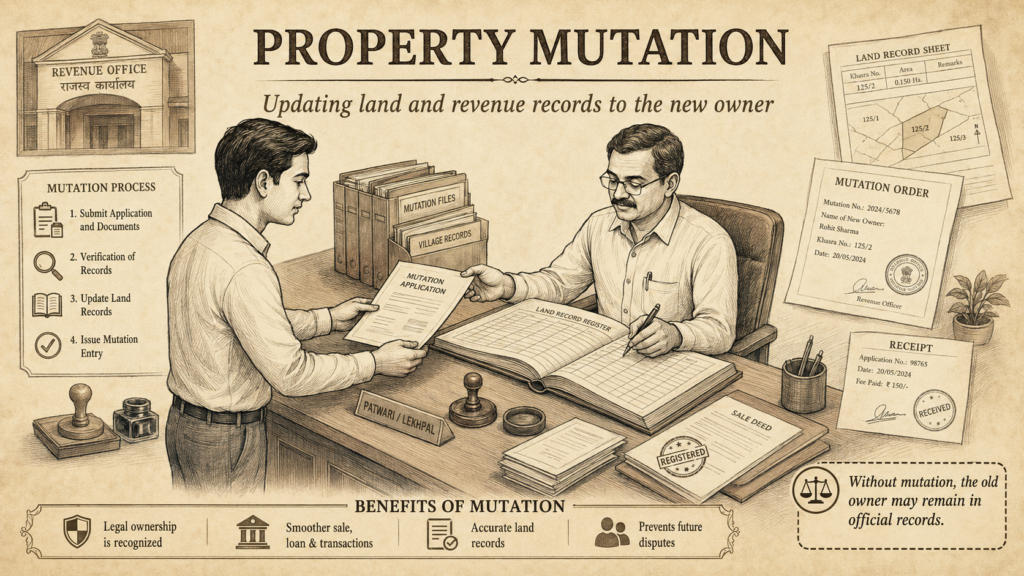
Property mutation is the process of updating government records to reflect a change in ownership after registration. It is the administrative follow-through that completes what your sale deed legally accomplished.

In Karnataka, this update lives in two parallel systems depending on where your property sits:

  • Urban property (Mysuru, Bengaluru, Mangaluru, Hubballi): Mutation happens through the e-Khata portal maintained by the city municipal body — MUDA and Mysuru City Corporation (MCC) for Mysuru, BBMP for Bengaluru, and equivalent authorities elsewhere.
  • Rural and agricultural land: Mutation means updating the RTC (Record of Rights, Tenancy and Crops) through the Bhoomi Karnataka portal or the Village Accountant at the Taluk office.

The legal backbone is the Karnataka Land Revenue Act, 1964 (Sections 128, 129, 133, and 136), which obliges anyone acquiring rights in land — through purchase, inheritance, gift, partition, or court order — to report the transaction so records can be updated.

The Single Most Important Distinction: Mutation Is Not Registration

This is the conceptual clarity that 90% of first-time buyers miss.

AspectRegistrationMutation
PurposeLegally records the transfer of ownership rightsUpdates government records to show the new owner
AuthoritySub-Registrar Office (Department of Stamps and Registration)MUDA/MCC/BBMP for urban, Revenue Department for rural
Document ProducedRegistered Sale DeedKhata Certificate / Mutation Register (MR) Entry / Updated RTC
What It ProvesLegal titleAdministrative recognition for tax, loans, utilities
Mandatory?Yes, before ownership transfersYes, to complete the transfer in records

Your sale deed gives you legal title. Mutation makes sure the government, your bank, the electricity board, and the next buyer all agree on it.

Three things mutation does not do:

  1. It does not transfer legal title. Registration does that.
  2. It does not cure title defects. If your sale deed has problems, mutation will not fix them. This is why pre-registration title verification is non-negotiable.
  3. It does not clear encumbrances. Outstanding loans, liens, or court cases remain regardless of whether mutation is complete.

Why Mutation Matters: The Real Costs of Skipping It

Buyers often delay mutation because the legal sale is done and the process feels like paperwork. The cost shows up later:

  • Home loan rejections on resale. Banks pull khata extracts during loan processing. If your name is not on the khata, the bank treats your title as suspect.
  • Property tax notices to the wrong person. Until the khata reflects your name, MCC, MUDA, or BBMP will keep sending tax demands to the previous owner. Disputes follow.
  • Utility transfer delays. Water and electricity connections in Karnataka are linked to khata records. Sale of khata mismatched properties often blocks BWSSB, Vani Vilas, or BESCOM/CESC transfers.
  • Future resale complications. Your next buyer’s lawyer will pull a 30-year title chain. Gaps in mutation create red flags that drop sale price or kill the deal.
  • Inheritance disputes. When a property passes to heirs without mutation completed, sibling disputes turn into court cases.

The fee is modest. The cost of skipping it is not.

Mutation in Property in Mysuru: MUDA, MCC, and the Two-Layer Reality

Mysuru property mutation has a wrinkle that Bengaluru buyers do not face: most residential plots are originally allotted by the Mysore Urban Development Authority (MUDA), then transferred to the Mysuru City Corporation (MCC) for ongoing tax and civic administration.

This creates two scenarios:

Scenario 1: Property still under MUDA jurisdiction. New layouts and recently allotted sites stay with MUDA for the first few years. Mutation is filed at the MUDA office at Jaladarshini Guest House Road, with khata records maintained by MUDA’s revenue section.

Scenario 2: Property transferred to MCC jurisdiction. Once a MUDA layout is handed over to MCC, you need a fresh MCC khata. This typically requires:

  • Notarised site documents
  • Latest Encumbrance Certificate (EC) for the relevant period
  • MUDA allotment letter or possession certificate
  • Property tax receipts
  • A khata transfer fee (currently around ₹2,100 for a 40×60 site, though this varies)

The MUDA-to-MCC transition has been a recurring sore point for Mysuru homeowners — some residents have argued in local press that the transfer should be administrative and free of cost to the citizen. Until that policy changes, treat the fresh MCC khata as a necessary step and budget for it.

For tax payment after mutation, MUDA-allotted properties use the mudamysuru.co.in portal under “Pay Property Tax Online”, which accepts site number, khata holder name, or mobile number as search criteria.

Mutation in Property in Bengaluru: The BBMP e-Khata System

Urban property mutation in Bengaluru moved fully digital in 2024. Paper khata certificates are no longer being newly issued; every khata transfer now happens through the e-Khata portal at bbmp.gov.in and the e-Aasthi system at bbmpeaasthi.karnataka.gov.in.

The biggest 2024-2026 shift is Aadhaar-based automatic mutation. When a sale deed is registered through the Kaveri 2.0 portal and both seller and buyer Aadhaars match the e-Khata records, mutation can auto-approve after a 7-day objection window — no separate application needed.

For disputed cases, mismatched records, or older properties without Aadhaar-seeded khatas, the manual e-Khata workflow applies:

  1. Access the BBMP e-Khata portal and create an account using PAN and mobile number
  2. Link Aadhaar (mandatory since 2024)
  3. Enter property PID (Property Identification Number), seller details, sale deed number, and consideration amount — exactly as per the sale deed, since discrepancies cause 70% of rejections
  4. Upload registered sale deed, encumbrance certificate, latest property tax receipt
  5. Pay the mutation fee online
  6. Track status via the application reference number

Turnaround for clean files has dropped from 90–120 days in the paper era to 30–45 days post-digitisation.

Mutation for Rural and Agricultural Land: RTC and Bhoomi

If your property is outside urban municipal limits — agricultural land, gram panchayat areas, or revenue villages — mutation works differently.

Here, mutation updates the RTC (Record of Rights, Tenancy and Crops), also called Pahani, maintained by the Revenue Department. The platform is Bhoomi Karnataka (landrecords.karnataka.gov.in), which received a major upgrade as Bhoomi 2.0 in 2024.

Most rural RTC updates are now trackable online through the Bhoomi portal, though Village Accountant physical verification remains part of the process in most districts. The workflow:

  1. Apply at the Taluk office or through the Village Accountant
  2. Submit the sale deed, EC, latest land revenue receipt, and ID proof
  3. Village Accountant verifies the change and files a Mutation Register (MR) entry
  4. Notices are issued to interested parties (a 30-day objection period applies in most cases)
  5. If no valid objections, the Tahsildar or competent officer certifies the entry
  6. The RTC is updated and a new Pahani is issued in your name

Rural mutation timelines run 30–60 days for clean files and can stretch significantly when survey numbers, extent, or boundary descriptions have minor mismatches.

Documents Required for Property Mutation in Karnataka

The exact list varies by jurisdiction and case type, but these documents cover roughly 90% of real cases:

Core documents (always required):

  • Registered Sale Deed (certified copy) — or Gift Deed, Release Deed, Partition Deed, Will, or court order depending on the transfer type
  • Latest Encumbrance Certificate (EC) covering the transaction period
  • Latest property tax paid receipt (no outstanding dues)
  • Khata extract or RTC of the previous owner
  • PAN and Aadhaar of the new owner

Case-specific additions:

  • Inheritance: Death certificate of previous owner, succession certificate or legal heirship certificate, family tree, NOC from co-heirs where applicable
  • Gift: Registered gift deed, donor’s identity proof
  • Court order transfer: Certified copy of the court decree
  • Joint property: Partition deed or relinquishment deed if mutation is to be in a single heir’s name

Verification documents:

  • Mother deed (previous title deeds to trace 15–30 year ownership history)
  • Affidavit on stamp paper declaring no disputes or encumbrances
  • NOC from the municipal corporation (case-specific)

From practical experience, the most common rejection trigger is small mismatches — spelling variations, survey number discrepancies, extent differences, PID/ePID inconsistencies, or boundary description gaps. Verify every detail against the sale deed before you submit.

Mutation Fees in Karnataka: What 2026 Guidance Value Revisions Changed

Urban mutation fees in Karnataka are typically calculated as approximately 2% of stamp duty paid during registration. Rural mutation charges are far lower — often a flat administrative fee.

The February 2026 guidance value revision materially shifted the math:

  • Bengaluru: 6–15% guidance value hike
  • Mysuru: 6–10% guidance value hike

Because stamp duty is calculated on the higher of declared consideration or guidance value, the baseline for mutation fees rose accordingly. On a ₹75 lakh Bengaluru property, mutation fees increased by roughly ₹1,500–₹3,500 compared to pre-revision rates. The percentage looks small, but stacked on stamp duty, registration, and the mutation fee itself, the total transactional cost in 2026 is meaningfully higher than 2024 budgets assumed.

Special-case fees worth knowing:

  • Family transfers via gift deed (parent to child, between spouses) attract concessional mutation fees — as low as ₹500–₹625 total in BBMP under the auto-mutation system
  • B Khata to A Khata conversion (where applicable) involves separate betterment charges
  • MCC fresh khata after MUDA transfer typically runs ₹2,100–₹3,500 depending on plot size

Step-by-Step: How to Apply for Property Mutation in Karnataka

The process broadly follows seven steps regardless of jurisdiction:

  1. Complete sale deed registration first. Mutation cannot begin before registration is complete and the EC reflects the transaction.
  2. Assemble the document checklist. Incomplete documentation is the single biggest cause of rejections and delays.
  3. File the mutation application at the relevant portal or office — e-Khata portal for BBMP, MUDA/MCC office for Mysuru urban, Taluk office or Bhoomi portal for rural.
  4. Pay the mutation fee online or at the counter and retain the acknowledgement number (GSC number in Bengaluru, application ID elsewhere).
  5. Verification and field inspection. A Revenue Inspector or municipal officer may visit the property to verify measurements, possession, and building usage. For rural land, the Village Accountant conducts the verification.
  6. Objection period. A 7–30 day window allows interested parties to raise objections. In Aadhaar-matched BBMP cases, this is 7 days.
  7. Approval and certificate issuance. Once cleared, the new khata or updated RTC is issued. Download the certificate from the portal or collect from the office.

Track status online wherever possible. For delays beyond stated timelines, escalate through the Sakala grievance system or file an RTI.

Frequently Asked Questions

Is mutation mandatory after buying property in Karnataka?

Yes. While ownership flows from the registered sale deed, mutation is required for property tax, loans, utility connections, and future resale. In 2026, digitised property systems actively flag properties with outdated ownership records, and municipal bodies treat khata mismatch as a non-compliance issue.

What is the time limit to apply for mutation in Karnataka?

Best practice is to apply within 90 days of sale deed registration. Delays beyond this can trigger penalties in some jurisdictions and create complications if the property changes status (for example, MUDA-to-MCC transfer) during the gap.

What is the difference between khata transfer and mutation in Karnataka?

In urban Bengaluru and Mysuru, khata transfer and mutation refer to essentially the same process — updating municipal records to reflect the new owner. In rural areas, mutation specifically refers to updating the RTC maintained by the Revenue Department. Khata is a municipal record; RTC is a revenue record.

Can mutation be done online in Karnataka?

For BBMP areas, yes — fully online via the e-Khata portal since 2024. For Mysuru, MUDA accepts online tax payments but mutation applications often still involve office visits, especially for MUDA-to-MCC transitions. Rural mutations can be initiated through Bhoomi 2.0 but generally require Village Accountant verification in person.

Does mutation give me legal ownership of the property?

No. Legal ownership comes from the registered sale deed or court order. Mutation only records administrative recognition of the change for tax and government purposes. Title disputes are resolved through the registration trail, not the mutation entry.

What happens if my mutation application is rejected?

Rejection is usually due to incomplete documentation, name or survey number mismatches, pending property tax, or unresolved encumbrances. Resolve the underlying issue first, then re-file. If the rejection involves a dispute or third-party objection, you may need to engage a property lawyer to resolve the title or encumbrance question before mutation can proceed.

Is mutation required for inherited property?

Yes, mutation is critical for inherited property. Without it, the deceased person’s name continues on the records, and any future transfer, loan, or sale faces serious complications. Heirs must produce the death certificate, succession or heirship certificate, and either mutate jointly or submit relinquishment or partition deeds to finalise mutation in a single heir’s name.

The Bottom Line for Karnataka Buyers

Mutation in property is the often-overlooked completion step that converts a legal purchase into a fully administered ownership. In Karnataka — and especially in Mysuru where the MUDA-MCC layer adds complexity — skipping or delaying mutation creates compounding problems: loan friction, tax notice mix-ups, resale red flags, and inheritance disputes years down the line.

The 2024 e-Khata digitisation in Bengaluru and the Bhoomi 2.0 rollout statewide have shortened timelines materially, but they have also raised the bar on documentation precision. Get the paperwork exactly right, apply within 90 days of registration, and treat mutation as part of the purchase — not as something to “deal with later.”

If you are buying in Mysuru and unsure whether your plot is under MUDA or MCC jurisdiction, that is the first question to settle. The answer changes the office you visit, the documents you assemble, and the fees you budget for.


About this guide: This article is informational and reflects mutation and khata transfer procedures applicable in Karnataka as of May 2026, including the BBMP e-Khata digitisation (2024), Bhoomi 2.0 rollout, and February 2026 guidance value revisions. Procedures and fees are revised periodically by the respective authorities — verify current rates at the relevant portal before filing. This guide does not constitute legal advice; consult a qualified property lawyer for transaction-specific questions.

Leave a Comment

Your email address will not be published. Required fields are marked *

Scroll to Top