
If you own or plan to buy property in Bengaluru, e-Khata Bangalore is no longer optional. Since October 2024, a valid e-Khata has become mandatory for property registration, and from 1 July 2025 the Kaveri registration system began blocking any sale where a verified e-Khata is missing. In plain terms, without an e-Khata you cannot register, sell, gift, or mortgage a property inside city limits. This guide explains what the BBMP khata system now looks like, how e-Khata works across e khata Karnataka, how to apply, what it costs, and how to check your status in 2026.
It is written for property owners and buyers, not officials, so every section stays practical and current.
What Is E-Khata? (E-Khata Meaning)
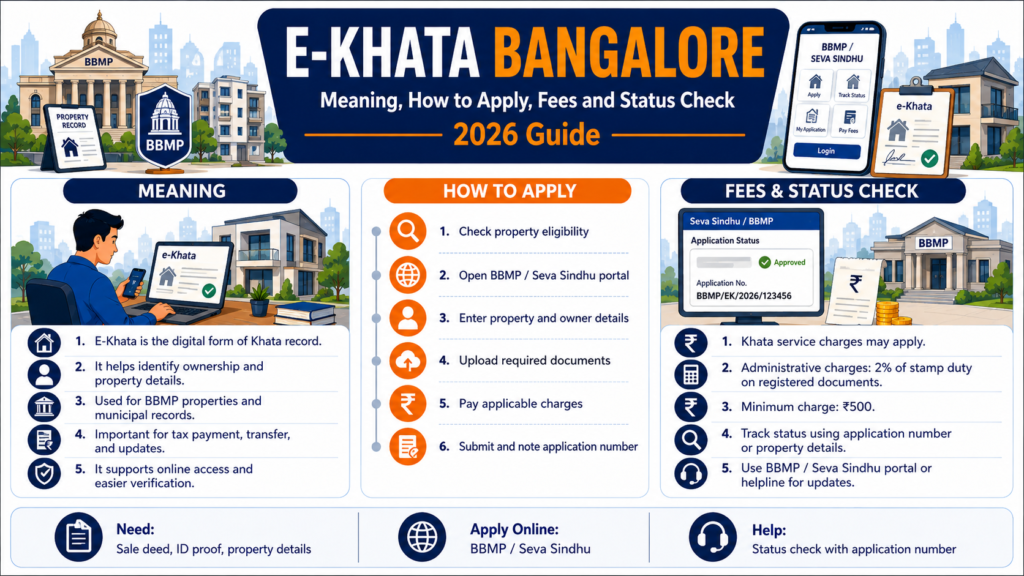
An e-Khata is the electronic version of the traditional Khata, the official municipal record that proves a property is entered in the civic body’s account for tax and ownership purposes. The word “Khata” means “account” in Kannada, so an e-Khata is simply the digital account of your property. It carries the owner’s name, property identification number, ward and zone, dimensions, and tax assessment details, all stored in one secure online database.
It helps to separate two terms that are often mixed up. e-Aasthi is the system, the digital property record platform maintained by the civic body, while e-Khata is the document that the e-Aasthi system produces. Every verified e-Khata is digitally signed, carries a QR code for verification, and is legally accepted by banks, sub-registrars, and courts.
One important change sits behind all of this. In September 2025 the BBMP was reorganised under the Greater Bengaluru Authority (GBA), and the city was split into five corporations. Existing e-Khatas, pending applications, and tax records all remained valid, and the e-Aasthi portal continued running, so most owners saw no disruption. You will now see the record referred to as a BBMP or GBA e-Khata.
Why E-Khata Is Now Mandatory in Bangalore
The Karnataka government made e-Khata mandatory to cut fraud and bring every property into a single verifiable registry. The rollout came in stages. From October 2024, e-Khata became compulsory for property transactions. From 1 July 2025, a verified e-Khata reference became mandatory to register a property under the Kaveri Online Services system and for building plan approvals, and applications without it were turned back at the sub-registrar’s counter. Enforcement tightened further from 1 November 2025.
The practical effect is simple. The registration portal itself blocks a sale if the e-Khata field is empty or unverified, so the sub-registrar cannot override it. Every property transaction in Bengaluru now begins with one question: does this property have a verified e-Khata? A verified e-Khata is also increasingly required for home loans, BESCOM electricity connections, and paying property tax in your own name, which is closely tied to how you pay BBMP property taxes online.
E-Khata vs A-Khata vs B-Khata
These three terms confuse most buyers, so here is the clean distinction. A-Khata and B-Khata describe the legal standing of a property, while e-Khata describes the format of the record.
- A-Khata: A property that is fully approved and compliant, eligible for building plan approval, home loans, and easy transfer.
- B-Khata: A property with pending issues such as layout deviations or unauthorised construction, which does not carry the same recognition and often needs regularisation.
- E-Khata: The digital version of either record. A property can have an e-Khata of its A-Khata or its B-Khata.
For a deeper comparison of the two categories and what each means for loans and resale, read our full guide to A Khata and B Khata for Bengaluru buyers. There is also good news for B-Khata owners in 2026: under a special window running from 15 May 2026 to 23 August 2026, the GBA reduced the B-Khata to A-Khata conversion fee from 5 percent to 2 percent of the guidance value for eligible properties.
Draft E-Khata vs Final E-Khata: The Difference That Matters
This is the single most misunderstood part of the system. A draft e-Khata is a pre-filled record that the civic body auto-generates from existing property data. It is not verified, and it is not valid for registration, sale, or building plan approval. Millions of draft khatas have been generated and even delivered to doorsteps, which leads many owners to assume the job is done.
A final e-Khata, also called a verified e-Khata, is one that you have reviewed, supported with documents, and had approved by the Assistant Revenue Officer (ARO) at your ward. Only the final e-Khata is legally usable. If you are buying a property, always confirm the seller holds a verified e-Khata, not just a draft.
Documents Required for E-Khata
Keeping documents ready avoids most delays. For a standard e-Khata application you will usually need:
- Registered sale deed or title deed
- Encumbrance Certificate (EC)
- Latest property tax paid receipts
- Aadhaar for e-KYC of the owner
- Approved building plan or layout plan
- Property photographs and GPS coordinates
- Previous Khata certificate or extract, if the property already has one
Two conditions block issuance almost every time: outstanding property tax, even a single unpaid quarter, and a name mismatch between the sale deed, the tax records, and your identity documents. Clear both before you apply.
How to Apply for E-Khata Online Through e-Aasthi
For most owners the entire process is online through the official BBMP e-Aasthi portal, with no office visit required. The steps below apply to a property that already has a manual A or B Khata.
- Log in. Visit the e-Aasthi portal and log in using your mobile number and OTP.
- Find your property. Go to the e-Khata section, select your zone and ward, and search using your name or your SAS property tax ID.
- Review the draft. If your property is in records, a draft e-Khata appears. Check every detail carefully.
- Choose the verified e-Khata. When asked, select the verified option, not the draft-only route.
- Upload documents and complete e-KYC. Attach the sale deed, EC, tax receipts, photos, and GPS data, and finish Aadhaar e-KYC.
- Pay the fee. Complete the payment online before submitting.
- ARO review. The Assistant Revenue Officer reviews the file, sometimes with a site visit, and issues the final e-Khata for download once approved.
New Khata BBMP: Properties With No Existing Khata
If your property has never had any Khata at all, the standard e-Aasthi conversion flow does not apply. Instead, a new khata BBMP application is filed on the dedicated New Khata portal at bbmp.karnataka.gov.in/newkhata. You register with your mobile number, open the apply-for-new-e-Khata section, enter full property details, upload your ownership and identity documents, pay online, and wait for ARO verification. In short: convert an existing A or B Khata through the e-Aasthi portal, but start a brand-new record through the New Khata portal.
E-Khata Fees and Charges in 2026
The core charges are modest, though they vary slightly by application type. As a working guide for 2026:
- E-Khata issuance or download: around ₹125, paid online via UPI or card.
- Khata transfer (mutation) fee: 2 percent of the stamp duty paid at registration, with a minimum of ₹500. On a property where you paid ₹2.5 lakh stamp duty, that is roughly ₹5,000.
- Service and scanning charges: a small service charge of around ₹40 to ₹45, plus a few rupees per page for scanning.
Because fees are revised periodically, always confirm the current amount on the official e-Aasthi portal before you pay. A Khata transfer after a purchase is closely linked to property mutation in the revenue records, so treat the two together.
How to Check E-Khata Status and Download Your Certificate
After you submit, the application moves through several stages: Submitted, then With Case Worker, then With ARO, then Signed by ARO, and finally Ready for download. You can track it on the e-Aasthi portal using your application number and registered mobile, or check the final record using your ePID.
Your ePID is a ten-digit Electronic Property ID assigned to the property. To download the final certificate, log in, enter the ePID, pay any pending mutation fee, and save the digitally signed PDF. A useful detail many people miss: your ePID also works as the password to open the downloaded PDF. Under Karnataka’s Sakala Services Act, the civic body is expected to process Khata applications within 30 working days, and you can escalate through the Sakala portal if yours stalls beyond that.
E-Khata Across Karnataka, Beyond Bangalore
The e khata Karnataka picture is wider than the BBMP area. e-Khata through e-Aasthi applies to urban properties within the GBA jurisdiction. Properties in gram panchayat and rural areas follow a different system, historically the e-Swathu portal, where Form 9 and Form 11 act as the ownership and demand records. Before you apply anywhere, confirm whether your property falls under an urban corporation or a panchayat, because applying on the wrong portal is a common and avoidable mistake. The same digital-first direction, verified records tied to Aadhaar and GPS, is steadily spreading across the state.
Common E-Khata Problems and How to Avoid Them
- Name mismatch. Even a small difference between the sale deed, Aadhaar, and tax records triggers rejection. Fix the mismatch before applying.
- Unpaid property tax. A single pending quarter blocks issuance automatically. Clear all dues first.
- Treating a draft as final. A draft e-Khata is not valid for any transaction. Always complete the verified route.
- Joint ownership showing one name. Correct ownership details early rather than after approval.
- Wrong jurisdiction. Urban properties use e-Aasthi, panchayat properties do not. Confirm before you start.
Why E-Khata Matters When You Buy Property
For a buyer, the e-Khata is the first document to verify, not the last. A verified e-Khata confirms the property is clean in municipal records, taxes are current, and the sale can actually be registered. A property stuck on a draft e-Khata, a B-Khata that needs conversion, or a name mismatch can delay a purchase by weeks and complicate your home loan. This is exactly the kind of due diligence that protects your money, whether you are buying apartments, plots and sites, or a home you plan to pass on through a will deed.
At Elite Build Infra Tech, legal clarity comes before every transaction. Our team verifies Khata status, tax records, and title before you commit a rupee. Explore Elite Build’s verified projects or talk to our advisory team for guidance on Khata, documentation, and property due diligence across Karnataka.
Frequently Asked Questions
What is e-Khata in Bangalore?
E-Khata is the electronic version of the BBMP Khata certificate, the municipal record that proves a property is registered in the civic body’s account. It stores the owner’s name, property ID, ward, dimensions, and tax details in the online e-Aasthi system and is now mandatory for property registration in Bengaluru.
Is e-Khata mandatory for property registration in Bengaluru?
Yes. Since October 2024, and firmly from 1 July 2025, a verified e-Khata is mandatory to register a property in Bengaluru. The Kaveri registration system blocks any sale where the e-Khata reference is missing or unverified, so registration cannot proceed without it.
What is the difference between draft e-Khata and final e-Khata?
A draft e-Khata is an auto-generated, unverified record and cannot be used for registration, sale, or loans. A final or verified e-Khata is approved by the Assistant Revenue Officer after document checks and is the only version that is legally valid for property transactions.
How do I apply for a new khata on the BBMP portal?
If your property already has an A or B Khata, convert it on the e-Aasthi portal at bbmpeaasthi.karnataka.gov.in. If it has no Khata at all, apply on the New Khata portal at bbmp.karnataka.gov.in/newkhata. Both use mobile OTP login, document upload, and online payment.
What documents are needed for e-Khata in Karnataka?
You typically need the registered sale deed or title deed, an Encumbrance Certificate, the latest property tax receipts, Aadhaar for e-KYC, the approved building or layout plan, property photographs with GPS coordinates, and any existing Khata extract. Clearing tax dues and fixing name mismatches first avoids rejection.
What are the e-Khata charges in Bangalore?
E-Khata issuance or download costs around ₹125. A Khata transfer after purchase attracts a mutation fee of 2 percent of the stamp duty paid, with a minimum of ₹500, plus a small service charge. Fees change periodically, so confirm current rates on the official e-Aasthi portal.
How can I check my e-Khata status online?
Log in to the e-Aasthi portal with your mobile number and OTP, then track the application using your acknowledgement number, or check the final record with your ten-digit ePID. Status moves from Submitted, to With ARO, to Signed, to Ready for download. Escalate via Sakala if it stalls beyond 30 working days.
Conclusion
E-Khata has moved from a convenience to a requirement. For any Bengaluru property, a verified e-Khata is now the gateway to registration, loans, and a clean resale. The rules are clear: confirm you hold a final e-Khata rather than a draft, clear your tax dues, match your name across documents, and use the right portal for your property type. Get this right and every future transaction becomes far smoother.
If you are buying in Karnataka and want your Khata, title, and tax records verified before you commit, speak with Elite Build Infra Tech for honest, end-to-end guidance.
About the author: This guide was prepared by the Elite Build Infra Tech advisory team, a Mysuru-based real estate consultancy focused on legally verified property, title due diligence, and transparent buyer guidance across Karnataka. The information here is for general awareness and reflects rules current as of July 2026. Government processes and fees change, so always confirm the latest details on the official e-Aasthi portal or with a qualified professional.
Last updated: July 2026.