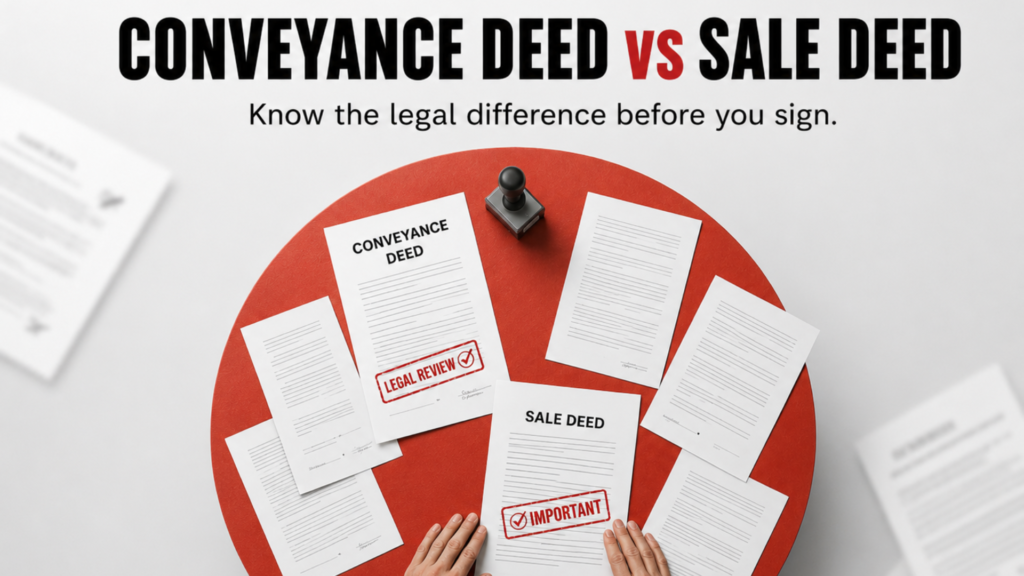
Buying property in India involves more paperwork than most buyers expect and two documents that create the most confusion are the conveyance deed and the sale deed. They sound similar. They are both legal documents. Both transfer property. But they are not the same thing, and confusing them can create serious legal complications for your ownership rights.
This guide breaks down exactly what each document is, where the difference lies, and which one you need whether you are buying an apartment from a builder, purchasing resale property, or inheriting land.
Quick Verdict: Conveyance Deed vs Sale Deed at a Glance
| Feature | Conveyance Deed | Sale Deed |
|---|---|---|
| Scope | Broader – all ownership transfers | Specific to purchase transactions |
| Types of transfer | Sale, gift, exchange, mortgage, inheritance | Only monetary sale |
| When used | Builder-to-buyer, gift deeds, society transfer | Direct purchase from individual seller |
| Consideration | May or may not involve payment | Always involves payment |
| Legal standing | Parent document (broader category) | Type of conveyance deed |
| Registration | Mandatory | Mandatory |
What is a Conveyance Deed?
A conveyance deed is a legal instrument that transfers the title, rights, and ownership of immovable property from one party (the transferor) to another (the transferee). The term “conveyance” in law simply means the act of transferring legal title.
The defining feature of a conveyance deed is its broad scope. It covers any legally recognised mode of property transfer including sale of property, gift of property, exchange between two parties, mortgage in some forms, transfer to a housing society, and builder transferring a flat to a buyer after construction.
A conveyance deed becomes especially important in builder-buyer transactions. When you purchase a flat from a developer, you typically sign an Agreement to Sell at booking. But that agreement does not transfer ownership to you. The actual legal transfer happens only when the builder executes a Conveyance Deed in your name – usually after the Occupancy Certificate (OC) is obtained. Thousands of apartment owners in India live in their homes for years without ever receiving a conveyance deed from the builder. Without it, the property is technically still in the builder’s name.
What is a Sale Deed?
A sale deed is a specific type of conveyance deed used when a property is sold for monetary consideration – meaning a fixed price is paid in exchange for ownership. It is the most common property document in India. When you buy a resale apartment, a plot of land, or a commercial property from an individual seller, the document that transfers ownership to you is a sale deed.
Unlike an Agreement to Sell (which is just a promise to sell), a sale deed is a completed transaction document. The moment it is signed and registered, the ownership of the property legally moves from the seller to the buyer. For a deeper understanding of all property deed types, see our guide on types of property deeds in India.
Conveyance Deed vs Sale Deed: Detailed Comparison
1. Nature of the Transaction
A sale deed is used exclusively when property changes hands for money. A conveyance deed can be used for all property transfers whether money is involved or not. A father gifting land to his son uses a gift deed, which is a type of conveyance deed.
2. Builder Transactions: Where the Confusion is Greatest
When you buy a flat from a developer, the transaction moves through: Allotment Letter (confirms booking), Agreement for Sale (legally binding promise), Possession Letter (physical handover), and then the Conveyance Deed (legal transfer of ownership, registered). In most builder transactions, the final document is called a Conveyance Deed because the developer is transferring title that covers common areas, undivided share in land (UDS), and housing society rights.
3. Legal Hierarchy: Parent vs Subset
All sale deeds are conveyance deeds. Not all conveyance deeds are sale deeds. Conveyance deed is the category. Sale deed is one specific type within that category.
4. Registration: Both Are Mandatory
Both documents must be registered under the Registration Act, 1908 and the Transfer of Property Act, 1882. An unregistered deed is legally unenforceable and cannot be used as evidence in court. In Karnataka, stamp duty is 5% of property value plus 1% registration fee. Undervaluing property to reduce stamp duty is a criminal offence.
Common Mistakes Buyers Make
Treating Agreement to Sell as ownership proof: An Agreement to Sell does not transfer ownership. Only a registered conveyance deed or sale deed does.
Not demanding conveyance deed from the builder: Without the deed, the property is not legally yours. Always demand the conveyance deed and ensure it is registered.
Ignoring undivided share of land (UDS): In apartment transactions, your ownership includes a proportional share of the land. A properly drafted conveyance deed specifies your UDS.
Skipping the Encumbrance Certificate: Before registering, obtain an EC for the past 13-30 years. This confirms the property is free of liens, mortgages, or disputes.
Frequently Asked Questions
Is a conveyance deed the same as a sale deed?
Not exactly. A sale deed is a type of conveyance deed. All sale deeds are conveyance deeds, but not all conveyance deeds are sale deeds. The conveyance deed is the broader parent category.
Can I get a home loan without a conveyance deed?
Banks require a registered conveyance deed or sale deed as the primary title document before approving a home loan. For under-construction properties, some lenders accept an Agreement to Sale, but the conveyance deed is essential for full disbursement.
What happens if the builder does not execute a conveyance deed?
You can file a complaint under RERA or approach the relevant state authority. In Maharashtra, the housing society can apply for Deemed Conveyance through the District Collector’s office.
What documents are needed to register a sale deed in Karnataka?
You need original title documents, PAN card, Aadhaar card, two passport photographs, property tax receipts, Encumbrance Certificate, and the draft deed on stamp paper of correct value. Both parties must present for biometric verification.
Conclusion: Get Your Ownership Document Right
The difference between a conveyance deed and a sale deed is not merely technical – it determines your legal ownership in court.
If you are buying a flat from a builder, do not accept possession without demanding and registering your Conveyance Deed. If you are buying resale property, ensure your Sale Deed is properly drafted, stamped, and registered at the Sub-Registrar’s office. Once your documentation is complete, do not forget to complete property mutation in your name.
At Elite Build, all our properties come with clean title chains and proper registered documentation. Whether you are looking for a MUDA-approved site in Mysore, an apartment in Mysore, a luxury villa in Mysore, a house in Mysore, or agriculture land in Mysore, every property comes with properly executed sale or conveyance deeds so your ownership is never in question.