Relinquishment Deed in Karnataka: Complete 2026 Guide

Relinquishment Deed in Karnataka: Complete 2026 Guide

What is a Relinquishment Deed?

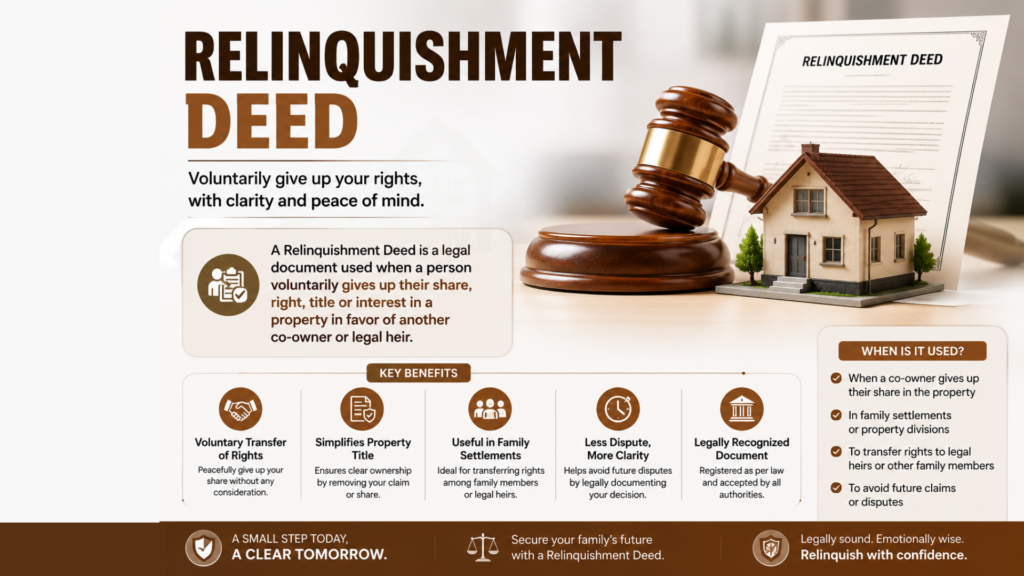
A relinquishment deed is a legal document through which a co-owner of an immovable property voluntarily gives up their share in favour of another existing co-owner — typically a family member or legal heir. It is governed by the Transfer of Property Act, 1882, and must be compulsorily registered under Section 17 of the Indian Registration Act, 1908, to be legally valid.

In Karnataka, a relinquishment deed (also called a release deed) is one of the most cost-effective ways to settle ownership of inherited or jointly purchased property between co-owners, with stamp duty significantly lower than that of a sale deed or, in many cases, a gift deed.

Quick fact: A relinquishment deed can only be executed between existing co-owners. It cannot be used to transfer property to a third party — that requires a gift deed or sale deed.


Why Relinquishment Deeds Matter for Karnataka Property Owners

Karnataka — and Bengaluru and Mysuru in particular — has seen a sharp rise in inherited property disputes as second- and third-generation heirs negotiate jointly held ancestral assets. A relinquishment deed offers a clean, registered, legally final route to consolidate ownership without the complexity of a full sale or the higher stamp duty of a gift deed to a non-relative.

Three trends make this instrument especially relevant in 2026:

  1. The August 2025 registration fee revision raised registration charges from 1% to 2% of property value across Karnataka, making accurate documentation more important than ever.
  2. Kaveri Online Services, Karnataka’s e-registration portal, now allows much of the pre-registration workflow — fee payment, appointment booking, document upload — to be completed remotely.
  3. Rising guidance values in Bengaluru and Mysuru mean even a single percentage point on stamp duty translates to substantial real money, so choosing the right instrument matters.

For families holding agricultural land near Mysuru, apartments in Bengaluru, or commercial property in tier-2 Karnataka towns, understanding when a relinquishment deed is the correct instrument — and when it is not — can save lakhs.


Key Features of a Relinquishment Deed

A relinquishment deed has six defining legal features that distinguish it from other property transfer instruments:

  • Co-ownership prerequisite: The releasor (person giving up the share) and releasee (person receiving it) must both already be co-owners of the same property.
  • Voluntary and informed: The relinquishment must be made out of free will, without coercion, fraud, or undue influence. Section 24 of the Transfer of Property Act explicitly requires this.
  • Compulsory registration: Under Section 17 of the Registration Act, 1908, the deed must be registered at the jurisdictional Sub-Registrar’s Office. An unregistered relinquishment deed is not admissible as evidence in court.
  • Stamp duty payable: Stamp duty is calculated only on the share being relinquished, not the whole property value.
  • With or without consideration: A relinquishment deed can be executed with or without monetary consideration. The presence of consideration does not invalidate it but may affect tax treatment.
  • Irrevocable once registered: It can only be cancelled if proven to have been executed under fraud, coercion, mistake, or without free consent.

Stamp Duty and Registration Charges in Karnataka (2026)

This is the section most property owners search for, so here are the current Karnataka rates as of 2026.

Family Member Transfers

When the relinquishment is between defined family members — parents, children, spouses, siblings — Karnataka offers concessional rates:

  • Stamp duty: 1% to 2% of the value of the share being released
  • Registration fee: 2% of the share value (revised from 1% with effect from 31 August 2025)
  • Cess and surcharge: Additional 10% cess and 2% surcharge on the stamp duty

Non-Family Transfers

If the co-owner receiving the share is not a defined family member, the transaction is treated similar to a sale deed:

  • Stamp duty: Up to 5% of the market value of the share
  • Registration fee: 2% of the share value

Worked Example: Bengaluru Apartment

Consider Anitha and her brother Rohan, who jointly own a flat in Whitefield, Bengaluru, with a market value of ₹1.2 crore. Rohan wants to release his 50% share (worth ₹60 lakh) to Anitha:

ChargeCalculationAmount
Stamp duty (1%)1% of ₹60,00,000₹60,000
Cess (10% on stamp duty)10% of ₹60,000₹6,000
Surcharge (2% on stamp duty)2% of ₹60,000₹1,200
Registration fee (2%)2% of ₹60,000₹1,20,000
Total₹1,87,200

By comparison, a gift deed for the same transaction would cost roughly ₹3,07,200 (5% stamp duty + registration), and a sale deed would touch ₹4 lakh or more. The savings are real.

Always verify the latest rates on the Kaveri Online Services portal (kaverionline.karnataka.gov.in) or with the Sub-Registrar’s Office before execution. Rates revise periodically.


Relinquishment Deed vs Gift Deed vs Sale Deed: Which One Do You Need?

This is the single most common confusion among Karnataka property owners. Here is a side-by-side breakdown:

FeatureRelinquishment DeedGift DeedSale Deed
PartiesMust be existing co-ownersDonor and donee — any relationshipSeller and buyer — any relationship
ConsiderationWith or withoutWithout consideration (love and affection)Monetary consideration mandatory
Stamp duty (Karnataka, family)1% to 2% of share value₹1,000 to ₹5,000 fixed (for specified relatives) or up to 5%5% to 6.5% of market value
RegistrationMandatory under Section 17Mandatory under Section 17Mandatory under Section 17
RevocabilityIrrevocable except for fraud, coercionIrrevocable except as stated aboveNot revocable; only voidable on legal grounds
Tax implicationsGenerally no income tax in family transfersExempt for specified relatives; otherwise taxable above ₹50,000Capital gains tax applies for seller
Best used forSettling co-owned inherited propertyVoluntary transfer to anyoneOpen-market property sale

A useful test from the Delhi High Court in Tripta Kaushik v. Sub Registrar VI-A clarifies the distinction: the nomenclature on the document is irrelevant — what matters is the actual character of the transaction. If you and the other party are not already co-owners, a “relinquishment deed” will be treated as a gift deed for stamp duty purposes, and the Sub-Registrar can reject the lower duty payment.


When Should You Use a Relinquishment Deed?

A relinquishment deed is the right instrument in five specific scenarios common to Karnataka families:

  1. Settling inherited ancestral property where multiple legal heirs hold undivided shares and one or more want to consolidate ownership in a single heir.
  2. Joint property between spouses or siblings where one party wants to formally exit the ownership structure — for example, after a separation or when one sibling is moving abroad.
  3. Post-death intestate succession when a parent dies without a will and the surviving spouse or one child takes the property with the consent of other heirs.
  4. Simplifying khata transfers in Bengaluru’s BBMP or Mysuru’s MCC, where consolidated ownership in a single name reduces friction during sale, mutation, or loan applications.
  5. Avoiding higher gift deed costs when the transfer is genuinely between co-owners and consideration is either nil or symbolic.

A relinquishment deed is not appropriate when:

  • The recipient is not already a co-owner
  • You want to transfer property to a charitable trust or a non-related third party
  • The property is being transferred against payment of the market price (use a sale deed)
  • There is no clarity on who all the legal heirs are (resolve title first)

Documents Required for Relinquishment Deed Registration in Karnataka

Keep this checklist ready before approaching the Sub-Registrar’s Office. Missing documents are the most common cause of rejected registrations.

  • Original title deed / parent document of the property
  • Encumbrance Certificate (EC) for the last 13 to 30 years from Kaveri Online
  • Latest property tax paid receipts (BBMP, MCC, or panchayat as applicable)
  • Khata certificate and khata extract in the name of current co-owners
  • Aadhaar card and PAN card of all parties (releasor, releasee, witnesses)
  • Two recent passport-size photographs of each party
  • Identity proof and address proof of two independent witnesses
  • Death certificate (if relinquishment follows intestate succession)
  • Legal heir certificate or family tree affidavit (where applicable)
  • Property card or RTC extract (for agricultural land in Karnataka)
  • Draft of the relinquishment deed itself, prepared on appropriate stamp paper
  • E-stamp paper purchased through the Kaveri portal or Stock Holding Corporation of India

For agricultural land in Karnataka, additional documents — Pahani, mutation extract (MR), and land conversion order if non-agricultural use is intended — may be required.


Step-by-Step: How to Register a Relinquishment Deed in Karnataka

The Karnataka registration process is now largely digital through the Kaveri Online Services portal. Here is the full sequence:

Step 1: Draft the Deed

Engage a property lawyer to draft the relinquishment deed. The deed must clearly state:

  • Full details of the releasor and releasee
  • Complete property description with survey number, khata number, and boundaries
  • The share being relinquished (e.g., one-half, one-third)
  • Whether the transfer is with or without consideration
  • A declaration of free will and absence of coercion
  • Reason for the relinquishment
  • Names, addresses, and signatures of two witnesses

Step 2: Calculate and Pay Stamp Duty

Log in to the Kaveri Online Services portal, calculate stamp duty using the integrated calculator, and pay through net banking or other accepted modes. Keep the e-stamp paper or e-challan ready.

Step 3: Book an Appointment

Through the same portal, schedule an appointment at the jurisdictional Sub-Registrar’s Office where the property is located. For Bengaluru properties, this will typically be the SRO in the relevant taluk; for Mysuru, the Mysuru District SRO offices.

Step 4: Visit the Sub-Registrar’s Office

On the appointed date, all parties — releasor, releasee, and two witnesses — must appear in person with original identity documents. The Sub-Registrar will:

  • Verify identities through biometric authentication
  • Confirm free consent of the releasor
  • Witness signatures of all parties
  • Capture photographs and thumb impressions
  • Register the document

Step 5: Collect the Registered Deed

The registered deed is usually available within five to seven working days, downloadable from the Kaveri portal in most cases. Keep multiple certified copies for future reference.

Step 6: Update the Khata

After registration, apply for khata transfer at BBMP, MCC, or the relevant panchayat. This step is critical — registration alone does not update municipal records, and an unupdated khata can block future transactions.


Common Mistakes to Avoid

Even experienced families make these errors. Each one can invalidate the deed or trigger costly disputes:

  • Treating the deed as informal: A relinquishment deed on plain paper, or one that is signed but unregistered, has no legal standing. Always register.
  • Using a relinquishment deed for non-co-owners: Courts and registrars will reclassify the document as a gift deed and demand the higher stamp duty, with penalty.
  • Skipping the encumbrance check: A property with an outstanding mortgage or pending litigation cannot be cleanly relinquished. Pull a current EC before drafting.
  • Ignoring tax implications: While relinquishment within a family is typically tax-neutral, transfers with significant consideration or to non-relatives can trigger income tax under Section 56(2) of the Income Tax Act.
  • Not updating khata and mutation records: Registration is only half the work. Without khata update, the consolidated owner cannot sell, mortgage, or even pay property tax in their name.
  • Drafting without legal review: Generic templates from the internet rarely capture Karnataka-specific requirements around survey numbers, RTC entries, and agricultural land restrictions.

Frequently Asked Questions

Can a relinquishment deed be cancelled after registration?

A registered relinquishment deed is irrevocable. It can only be challenged in court on specific grounds — fraud, coercion, mistake, misrepresentation, or absence of free consent. The challenger bears the burden of proof, and Karnataka courts treat registered deeds with strong presumption of validity. Cancellation by mutual consent is technically possible but requires a fresh registered cancellation deed.

Is stamp duty for a relinquishment deed lower than a gift deed in Karnataka?

Yes, in most cases. For relinquishment between co-owners who are family members, Karnataka levies 1% to 2% of the share value as stamp duty. A gift deed to a specified family relative attracts a fixed lower fee in some categories but a regular gift deed to others can attract up to 5% of market value. Always verify current rates with the Department of Stamps and Registration, Government of Karnataka before execution. The savings on a high-value Bengaluru property are typically significant.

Can an NRI execute a relinquishment deed for property in Karnataka?

Yes. A non-resident Indian who is a co-owner can execute a relinquishment deed. The NRI must either appear in person at the Sub-Registrar’s Office or grant a registered Power of Attorney (PoA) to a representative in India. If the PoA is executed abroad, it must be notarised, apostilled or attested by the Indian embassy, and then registered in India before use.

Does a relinquishment deed need to be made on stamp paper of a specific value?

The drafting can be done on a nominal ₹100 non-judicial stamp paper, but the actual stamp duty — calculated on the share value — must be paid separately through e-stamping via the Kaveri Online Services portal before registration. The Sub-Registrar will verify both before accepting the document for registration.

What happens if one co-owner refuses to sign the relinquishment deed?

A relinquishment deed requires the voluntary signature of the releasor. If a co-owner refuses, the other heirs cannot force the deed. The alternative routes are a partition suit in the civil court, mediation through a family settlement deed, or in some cases, a Lok Adalat proceeding. None of these can replicate the simplicity and cost-efficiency of a voluntarily executed relinquishment deed.

Is there any income tax on receiving property through a relinquishment deed?

For relinquishment between defined relatives under Section 56(2) of the Income Tax Act, 1961 — which covers spouse, siblings, parents, lineal ascendants and descendants — there is no income tax in the hands of the recipient, even where consideration is nominal or absent. For non-relative co-owners, the differential between consideration paid and stamp duty value (if more than ₹50,000) becomes taxable as income from other sources.

Can a minor co-owner’s share be relinquished?

A minor cannot independently execute a relinquishment deed. The natural guardian or a court-appointed guardian must act on the minor’s behalf, and the relinquishment requires prior permission from the appropriate court if the property value is significant. Courts typically allow this only when the transaction is demonstrably in the minor’s interest.


Closing: Get the Documentation Right the First Time

A relinquishment deed is one of the most elegant legal instruments in Indian property law — when it is used correctly. For Karnataka families managing inherited apartments in Bengaluru, ancestral land in Mysuru, or commercial property anywhere in the state, it offers a clean, low-cost path to consolidate ownership and avoid future disputes.

But the savings only materialise when the deed is drafted accurately, registered properly, and followed up with khata mutation. Skipping any of these steps — or using a relinquishment deed in the wrong situation — can convert a routine family settlement into a years-long legal battle.

If you are considering executing a relinquishment deed for a property in Karnataka, consult a property lawyer familiar with local Sub-Registrar practice and current Kaveri portal workflows. The legal fee is a fraction of the stamp duty saved.

Leave a Comment

Your email address will not be published. Required fields are marked *

Scroll to Top